How Federal Sentencing Works in Smithfield in 2026
Wondering how federal sentencing works in 2026? Learn key steps, guidelines, and your rights. Contact Vasquez Law Firm for a free consultation.
Published on July 16, 2026
Protect your record and your freedom
Free, confidential review. 24/7.
Free & confidential · Se habla espanol · 24/7
Have questions? Talk to an attorney - free evaluation.
Call 1-844-967-3536Protect Your Record and Your Freedom
A confidential case review - available 24/7 for emergencies.
How Federal Sentencing Works in Smithfield in 2026
Federal sentencing in Smithfield follows strict guidelines set by U.S. law. In 2026, understanding these rules is critical if you face criminal charges. This guide explains how federal sentencing works, the types of sentences, and what defendants in Smithfield and other North Carolina areas should know. Vasquez Law Firm provides trusted criminal defense to help protect your rights and navigate this complex process.
Need help with your case? Our experienced attorneys are ready to fight for you. Se Habla Español.
Or call us now: 1-844-967-3536
Quick Answer
Federal sentencing in Smithfield is guided by the 2026 United States Sentencing Guidelines, which provide ranges based on the offense and criminal history. Judges weigh multiple factors before imposing imprisonment, probation, fines, or alternatives. Understanding these rules helps defendants protect their rights and plan their defense.
- Sentences depend on offense severity and history
- Federal guidelines updated annually and apply nationwide
- Judges have discretion within guideline ranges
- Immediate incarceration depends on the case
- Legal defense influences sentence outcomes
Understanding Federal Sentencing
Imagine John Doe from Smithfield facing federal drug trafficking charges. After conviction, John’s sentence isn't automatic but guided by federal law. The United States Sentencing Commission issues an annual Federal Sentencing Guidelines Manual. This manual assigns offense levels and takes prior convictions into account, effectively creating a sentencing range.
Federal sentencing considers factors such as the nature of the crime, amount of harm, defendant's role, and history. 18 U.S.C. § 3553 outlines these in detail, mandating that courts impose sentences that reflect the offense’s seriousness, deterrence, protection of the public, and rehabilitation needs.
Because federal law applies nationwide, the federal sentencing process in Smithfield follows the same framework used throughout the country. However, local federal courts like the Eastern District of North Carolina, which includes Smithfield, apply these principles with regional nuances, including docket schedules and available programs.
Our criminal defense services can help you understand how these guidelines apply to your case and protect your rights during this crucial phase.
Three Types of Federal Sentencing
Federal judges mainly impose three types of sentences: imprisonment, probation, and fines/restitution. Sometimes these combine depending on the offense’s circumstances. Probation may include supervised release with conditions. Fines can be significant for financial crimes.
Federal Sentencing Impact in Smithfield
Although federal sentencing is uniform, local prosecutors and judges in Smithfield influence outcomes through plea deals and sentencing memoranda. Knowing the local court rules and tendencies helps defendants set realistic expectations.
Steps in the Federal Sentencing Process
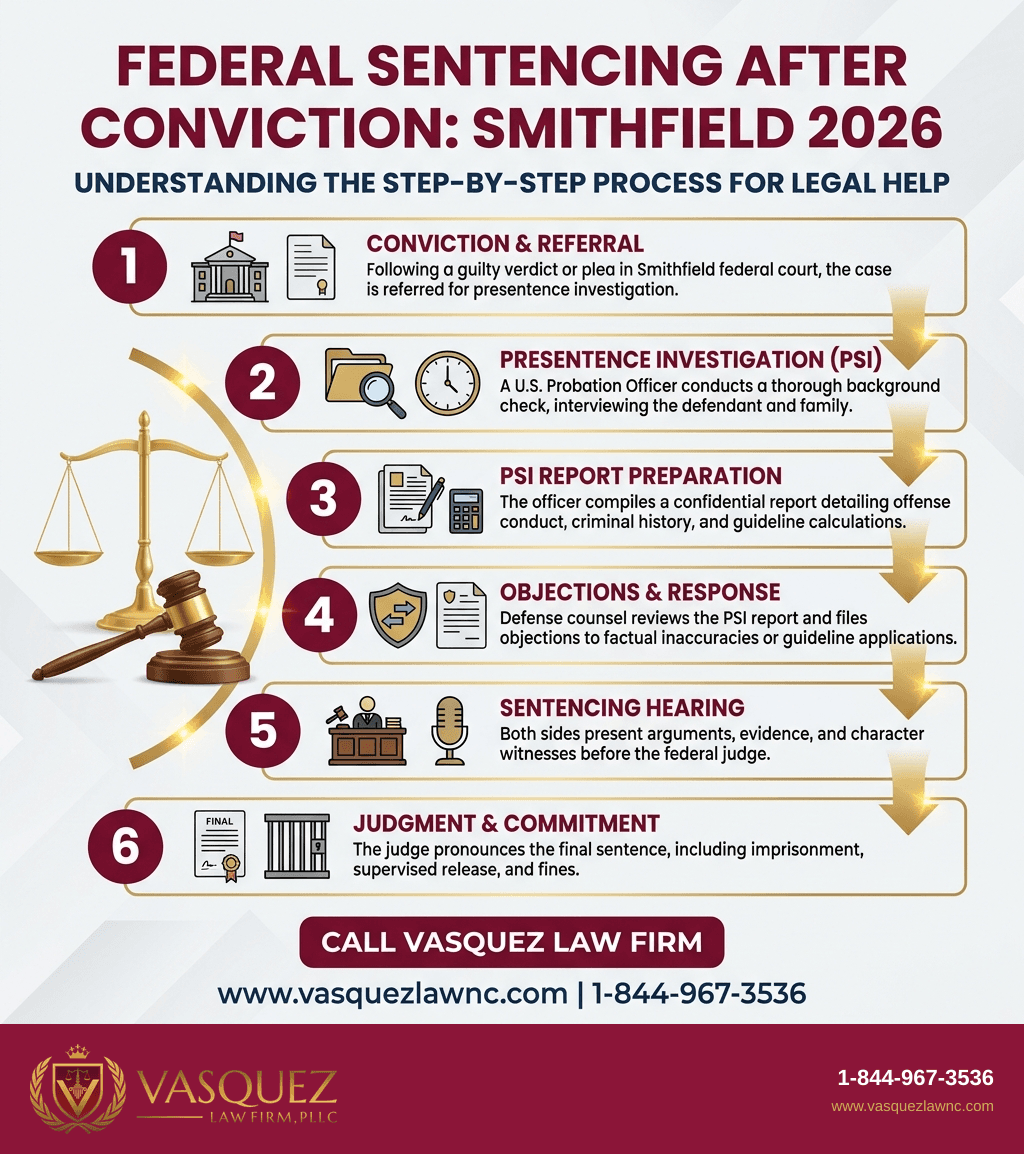
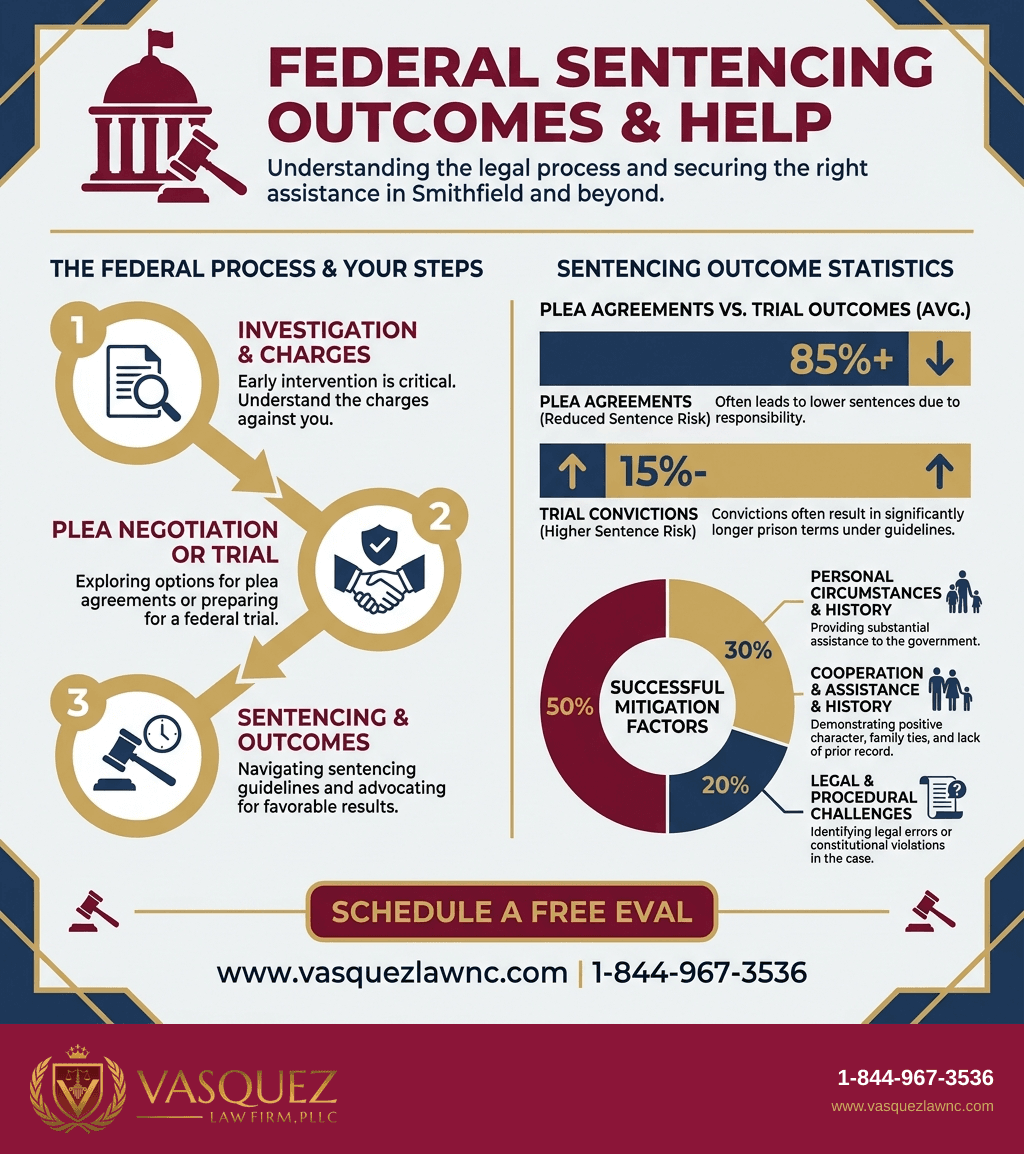
Federal sentencing follows a set process after conviction. Understanding these steps helps defendants anticipate what lies ahead in Smithfield.
Step 1: Conviction
After pleading guilty or being found guilty at trial, the sentencing phase begins. Conviction triggers the preparation of a Presentence Investigation Report (PSR) by probation officers.
Step 2: Presentence Report
Probation officers collect detailed information about the offense, defendant history, and circumstances. This PSR includes a recommended offense level and sentencing range based on federal guidelines.
Step 3: Sentencing Hearing
During the hearing, the judge considers the PSR, arguments from defense and prosecution, victim impact statements, and legal memoranda. The judge applies 18 U.S.C. § 3553 factors to decide on the final sentence.
Step 4: Imposition of Sentence
The judge announces the sentence, which may include imprisonment, probation, fines, or a combination. The defendant may be remanded immediately depending on the order.
Don't wait to get the help you deserve. Call us now for immediate assistance.
Federal Sentencing Guidelines and Tools
The Federal Sentencing Guidelines Manual 2026 is the authoritative source detailing how judges should calculate sentences. It assigns offense levels from 1 to 43 and criminal history categories from I to VI. Combined, these determine the sentencing range.
Federal Sentencing Guidelines Chart
The chart cross-references offense levels and criminal history to recommend months of imprisonment. For example, an offense level 20 with criminal history category II may result in a 33 to 41 month range.
Sentencing Guidelines Calculator
Online calculators help estimate guideline ranges based on case facts. They are useful tools to understand potential penalties but are not substitutes for legal advice.
Compliance Programs and Variances
Guidelines allow for variances based on factors such as cooperation or substantial assistance, which can reduce sentences. Defendants with compliance programs or mitigating circumstances may qualify for leniency.
Common Mistakes to Avoid in Federal Cases
- Ignoring Sentencing Guidelines: Failing to understand them can lead to surprises at sentencing.
- Not Hiring Experienced Defense: Federal sentences are complex, requiring skilled legal help.
- Missing Deadlines: Appeals and motions have tight windows; missing them forfeits rights.
- Pleading Without Counsel: Innocent defendants must still ensure legal protections.
- Underestimating Prosecutors: Federal prosecutors have significant resources and expertise.
- Failing to Gather Evidence: Mitigating evidence can affect sentencing outcomes.
- Assuming All Sentences Mean Prison: Some judges use probation or alternatives.
If you only remember one thing: federal sentencing requires prompt, knowledgeable defense to protect your rights and seek the fairest outcome.
Timeline and What to Expect in Smithfield
- Week 1-2: Arrest and initial court appearance.
- Week 3-6: Pretrial motions and plea negotiations.
- Week 7-10: Presentence Investigation Report preparation.
- Week 11-12: Sentencing hearing scheduled and held.
- Week 13+: Appeal window opens for 14 days post sentencing.
This timeline may vary depending on case complexity and court schedules but gives a general idea of the federal sentencing process in the Eastern District of North Carolina, which covers Smithfield.
When to Call a Federal Criminal Defense Lawyer
- If you have been charged with a federal crime in Smithfield.
- When facing possible imprisonment or significant fines.
- If you want to understand how federal sentencing guidelines affect your case.
- If you need to file appeals or motions before sentencing.
- Upon receiving a Presentence Report draft.
- Before entering a plea agreement.
- To challenge evidence used in guideline calculations.
- If you want to negotiate cooperations or sentencing variances.
About Vasquez Law Firm
At Vasquez Law Firm, we combine compassion with aggressive representation. Our motto "Yo Peleo®" (I Fight) reflects our commitment to standing up for your rights.
- Bilingual Support: Se Habla Español — Spanish-speaking attorneys and staff available
- Service Areas: North Carolina including Smithfield and surrounding counties
- Experience: Over 30 years helping clients navigate complex legal matters
- Results: Thousands of successful cases across multiple practice areas
Attorney Trust and Experience
William J. Vásquez is admitted to the North Carolina State Bar (2011) and to the U.S. Courts of Appeals for the 4th, 5th, and 11th Circuits. The firm has provided dedicated legal representation since 2011, with personalized attention to each client's case.
Don't wait to get the help you deserve. Call us now for immediate assistance.
Frequently Asked Questions
How does federal sentencing work?
Federal sentencing follows structured guidelines to ensure consistency while allowing judicial discretion. Judges calculate offense levels and criminal history to determine sentencing ranges, considering factors like crime severity and defendant background under 18 U.S.C. § 3553. This system helps balance punishment, deterrence, and rehabilitation nationwide.
Do you go straight to jail after federal sentencing?
Not always. Some defendants may remain free on appeal or bond. However, many sentences require immediate incarceration, especially in serious offenses. Judges issue remand orders based on case specifics and risk factors, so it varies by situation and jurisdiction.
What are the three types of federal sentencing?
The primary sentencing types are imprisonment, probation, and fines or restitution. Judges can impose them individually or in combination. Probation often includes supervision. Fines are common in financial crimes. The type depends on the offense, defendant’s history, and guideline recommendations.
How serious is a federal charge?
Federal charges carry potentially harsh penalties including long prison terms and high fines. They are treated seriously by prosecutors. The level of seriousness depends on the offense but generally exceeds state charges due to federal law enforcement priorities.
What is a federal sentencing guidelines chart?
The chart is a tool created by the US Sentencing Commission illustrating sentencing ranges based on offense levels and criminal histories. The 2026 chart adjusts recommendations to reflect legislative changes and court decisions, helping judges impose consistent sentences.
Can federal sentencing be appealed?
Yes. Defendants can appeal sentences within 14 days following sentencing if legal or procedural errors are alleged. Appeals may result in resentencing, reduced sentences, or other remedies if successful.
What is the role of a criminal defense lawyer in federal sentencing?
Defense lawyers analyze the guidelines, challenge evidence, negotiate plea deals, and present mitigation to achieve fair sentences. They protect constitutional rights and navigate complex federal rules on behalf of defendants in Smithfield and elsewhere.
How do federal sentencing guidelines impact local cases in Smithfield?
Local court judges in Smithfield apply these nationwide guidelines alongside North Carolina laws. Awareness of federal guidelines helps defendants understand potential sentences specific to this district and prepare an effective defense strategy.
Sources and References
Take the first step toward justice today. Our team is standing by to help.
Start Your Free Evaluation Now
Call us: 1-844-967-3536
Se Habla Español - Estamos aquí para ayudarle.


William Vasquez
Founder & CEO, Vasquez Law Firm, PLLC
William Vasquez is the founder and CEO of Vasquez Law Firm, PLLC, a results-driven firm specializing in immigration, criminal defense, personal injury, and workers' compensation. A U.S. Air Force veteran and recipient of the Joint Service Achievement Medal, William is dedicated to fiercely fighting for his clients' rights.
Related Legal Services
Need legal help? Learn more about speak with a criminal defense lawyer, or contact us for a free evaluation.
You can also visit our NC defense attorneys for more information.