How H-1B Visa Works and What You Should Know in 2026
Wondering how the H-1B visa works in 2026? Learn requirements, salary, and application details. Contact Vasquez Law for a free consultation today.
Published on June 9, 2026
Talk to an immigration attorney
Free call. A clear plan for your case.
Free & confidential · Se habla espanol · 24/7

Have questions? Talk to an attorney - free evaluation.
Call 1-844-967-3536Worried how the latest immigration news affects you?
Schedule a confidential case review with an immigration attorney - know exactly where you stand.
How H-1B Visa Works and What You Should Know in 2026
The H-1B visa is a popular work visa allowing U.S. employers to hire foreign professionals in specialty occupations. In 2026, applying for an H-1B visa involves meeting strict requirements, understanding salary criteria, and following a detailed process. If you live in Raleigh, NC or Orlando, FL, and are considering an H-1B visa, understanding these steps is critical. This article explains the key aspects of eligibility, application, timelines, costs, and common mistakes to avoid to help you navigate the complex immigration system effectively.
Need help with your case? Our experienced attorneys are ready to fight for you. Se Habla Español.
Or call us now: 1-844-967-3536
Quick Answer
The H-1B visa is a non-immigrant visa for specialty occupations requiring a bachelor's degree or higher. It allows foreign workers to be employed by U.S. companies temporarily, with potential for extension and green card eligibility. Employers must meet wage and job criteria while applicants follow a detailed application process administered by USCIS.
- Requires a job offer in a specialty occupation
- Minimum bachelor's degree or equivalent needed
- Employers must pay prevailing wage
- Valid for up to 3 years, extendable
- May lead to green card through employment
Understanding the H-1B Visa
Imagine a Raleigh-based tech company needs to hire a software developer with specialized skills not readily found locally. The H-1B visa enables them to legally employ a qualified foreign worker. This visa applies to specialty occupations requiring theoretical or technical expertise, such as engineers, scientists, accountants, or medical professionals. The U.S. Citizenship and Immigration Services (USCIS) governs this program under federal regulations, ensuring applicants meet defined criteria.
The H-1B visa is typically granted for an initial period of up to three years with a possibility of extension up to six years in total. Under 8 U.S.C. § 1184(c) and 8 C.F.R. § 214.2(h), the employer must submit a petition demonstrating the job qualifies as a specialty occupation and that the applicant possesses the required qualifications.
Salary requirements mandate paying the prevailing wage for the position in the specific geographic area. This protects both the worker and U.S. labor market integrity. In 2026, the application process remains competitive, involving a lottery system due to high demand. Understanding these basics is essential before starting your H-1B journey.
Step-by-Step H-1B Application Process
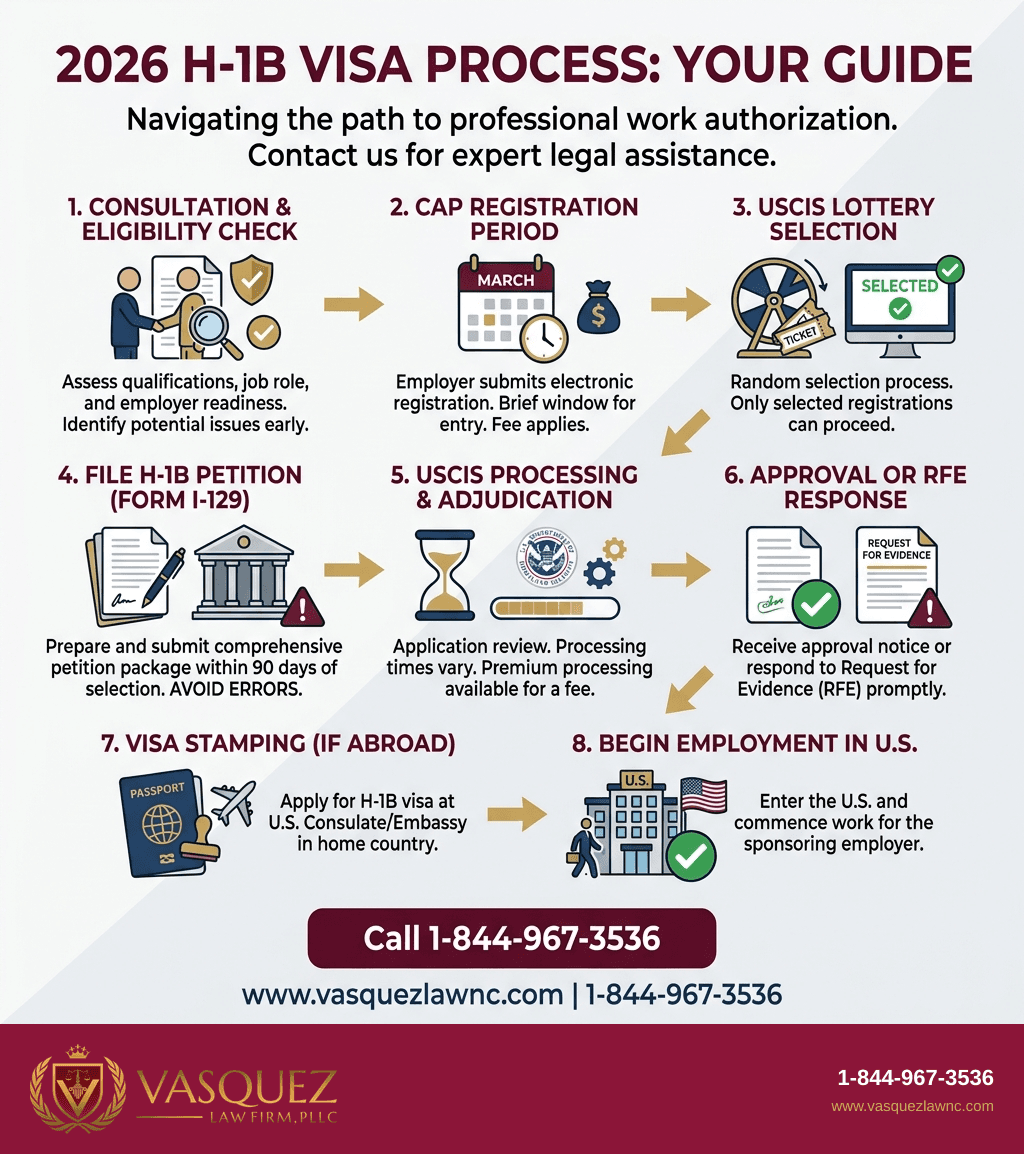
- Employer Registration for Lottery: The employer registers the prospective employee in the USCIS electronic system during the designated registration window, usually in March. Registration is mandatory for lottery participation.
- Lottery Selection: USCIS conducts a randomized lottery if registrations exceed the annual cap of 85,000 visas (65,000 regular plus 20,000 advanced degree).
- Petition Filing: If selected, the employer files Form I-129, Petition for a Nonimmigrant Worker, including wage documentation and proof of specialty occupation.
- Processing Waiting Period: USCIS processes the petition. Regular processing typically takes 6 to 8 months; premium processing lowers this to 15 days (see USCIS Processing Times).
- Approval and Work Authorization: After approval, applicants outside the U.S. apply for H-1B visas at consulates or adjust status if inside the U.S.
- Maintain Status and Renew: The visa holder works under the employer’s sponsorship and can seek extensions or adjustment of status.
Each step requires careful attention to meeting deadlines and providing accurate documentation. Employers and employees should cooperate closely to meet petition requirements as outlined in the USCIS Policy Manual.
Common Mistakes to Avoid in the H-1B Process
- Incomplete Applications: Missing pages, signatures, or required documents can cause denials or delays.
- Non-qualifying Job Titles: Filing for jobs not meeting specialty occupation criteria leads to petition denials.
- Incorrect Prevailing Wage: Paying below prevailing wage violates regulations and risks revocation.
- Missing Deadlines: Late petitions or failing to register timely causes missed opportunities.
- Unauthorized Employment: Working before approval or for another employer without transfer approval may result in visa loss.
- Ignoring Lottery Rules: Failing to register properly or misunderstanding lottery procedures wastes chances.
- Poor Documentation of Qualifications: Insufficient proof of education or experience damages applications.
If you only remember one thing: Planning and accuracy are critical to a successful H-1B application.
Timeline and What to Expect for Your H-1B Visa
- March-April: Employer registration period for the lottery.
- April-May: Lottery selections announced, petitions filed for selected candidates.
- June-December: USCIS processes petitions. Approval notices typically issued during this phase.
- October 1: Earliest start date for H-1B employment if the case is approved.
- Renewal Timing: Extension petitions can be filed up to six months before visa expiration.
- Longer Delays: Requests for Evidence (RFEs) may add weeks or months depending on case complexity.
Understanding this timeline can help applicants and employers align their plans, especially in Raleigh and Orlando, where demand for skilled workers is strong.
Costs and Fees You Should Know
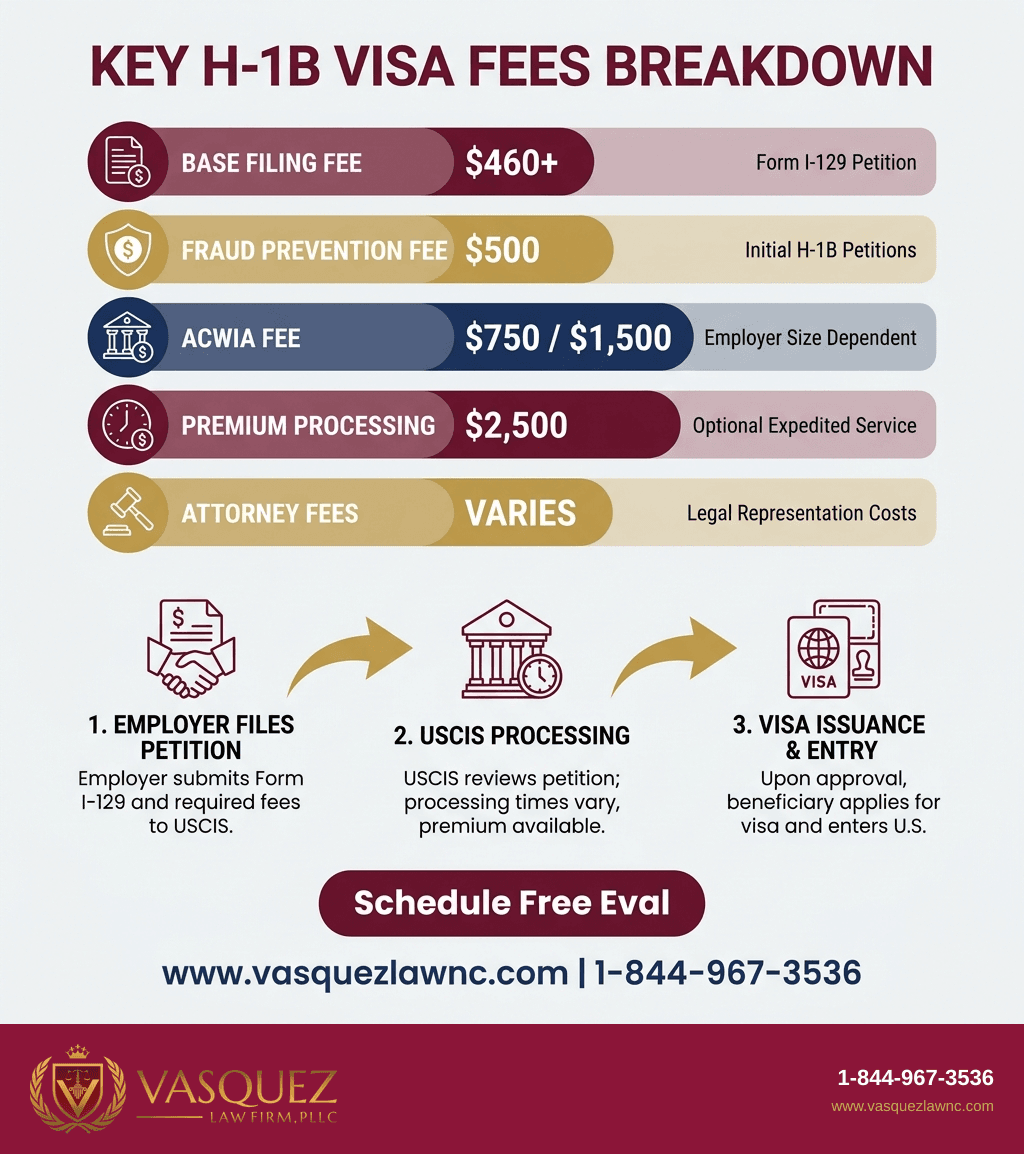
- Basic USCIS Filing Fee: The standard filing fee for Form I-129 is currently $460.
- American Competitiveness and Workforce Improvement Act (ACWIA) Fee: $750 to $1,500 depending on employer size.
- Fraud Prevention and Detection Fee: $500 for initial H-1B petitions or change of employer petitions.
- Public Law 114-113 Fee: $4,000 fee applies to certain employers with a high proportion of H-1B employees; this fee has been disputed recently but remains in place as of 2026.
- Premium Processing: Optional $2,500 fee guarantees decision within 15 calendar days.
- Attorney Fees: Vary depending on law firm and case complexity, typically between $2,000-$5,000.
Factors affecting costs include employer size, petition category, and whether premium processing is used. Attorneys at Vasquez Law Firm can provide tailored estimates.
Jurisdictional Notes for Raleigh, NC and Orlando, FL
North Carolina Notes
In Raleigh, NC, H-1B filings follow federal regulations. Local employers, especially in the tech sector and universities, frequently participate in the H-1B program. Applicants should work with attorneys familiar with the NC labor market and USCIS regional processing centers impacting timing.
Florida Notes
Orlando-area employers also regularly sponsor H-1B workers, particularly in hospitality management, healthcare, and IT. Florida employers must ensure compliance with state wage laws alongside federal requirements.
Nationwide Concepts
Federal law governs the H-1B visa throughout the United States; however, the lottery process and adjudication centers can vary by region. Applicants nationwide face the lottery cap and must meet identical requirements under 8 U.S.C. § 1184(c).
When to Call a Lawyer for Your H-1B Visa
- If you receive a Request for Evidence (RFE) from USCIS.
- If your petition is denied or delayed unusually.
- If you need help understanding wage and job classification rules.
- If your employer plans to change your work location or job duties.
- If you want to apply for a green card based on your H-1B status.
- If you face questions about maintaining status during employment gaps.
- If you're unsure about working for multiple employers or transferring your visa.
- If you want to plan extensions beyond the initial six years.
About Vasquez Law Firm
At Vasquez Law Firm, we combine compassion with aggressive representation. Our motto "Yo Peleo®" (I Fight) reflects our commitment to standing up for your rights.
- Bilingual Support: Se Habla Español — Spanish-speaking attorneys and staff available
- Service Areas: North Carolina, Florida, and nationwide immigration services
- Experience: Over 30 years helping clients navigate complex legal matters
- Results: Thousands of successful cases across multiple practice areas
Attorney Trust and Experience
William J. Vásquez is admitted to the North Carolina State Bar (2011) and to the U.S. Courts of Appeals for the 4th, 5th, and 11th Circuits. Florida-jurisdiction matters at the firm are handled by Florida Bar attorney Harold Estrada-Rodriguez (FL Bar No. 1041171). The firm has provided dedicated legal representation since 2011, with personalized attention to each client's case.
Don't wait to get the help you deserve. Call us now for immediate assistance.
Se Habla Español
Frequently Asked Questions
What is an H-1B visa?
The H-1B visa is a non-immigrant visa for specialty occupations requiring a bachelor's degree or higher. It allows foreign professionals to work in the U.S. temporarily with employer sponsorship.
Who is eligible for an H-1B visa?
Eligibility requires a U.S. job offer in a specialty occupation and the worker must have at least a bachelor’s degree or equivalent in a related field. Employers must validate the specialty nature of the job.
Does an H-1B visa lead to a green card?
Yes. Many H-1B holders apply for an employment-based green card. However, the process is separate and requires employer sponsorship and adherence to additional procedures.
What is the typical salary requirement for H-1B visas?
Employers must pay at least the prevailing wage for the job in the area where the employee will work to ensure fair compensation and protect U.S. labor markets.
How long does the H-1B visa application process take?
Regular processing takes 6-8 months; premium processing takes 15 days. Processing may be delayed by requests for more evidence or high demand during the lottery period.
What are common mistakes applicants make with H-1B visas?
Common mistakes include incomplete applications, missing sign-offs, wrong wage details, and working before approval. Proper legal guidance helps avoid these errors.
Can I work for multiple employers on an H-1B visa?
No, unless each employer files and receives approval for a separate H-1B petition. Unauthorized employment can result in serious consequences.
What happens if my H-1B petition is denied?
You can file an appeal or motion to reopen depending on denial reasons. Alternative visa options or waiting to reapply may also be necessary. Early legal help is recommended.
Sources and References
- U.S. Citizenship and Immigration Services
- Executive Office for Immigration Review
- Legal Information Institute
Take the first step toward justice today. Our team is standing by to help.
Start Your Free Evaluation Now
Call us: 1-844-967-3536
Se Habla Español - Estamos aquí para ayudarle.
If you need legal assistance, learn more about immigration case consultation, or call us at 1-844-967-3536 for a free evaluation.

William Vasquez
Founder & CEO, Vasquez Law Firm, PLLC
William Vasquez is the founder and CEO of Vasquez Law Firm, PLLC, a results-driven firm specializing in immigration, criminal defense, personal injury, and workers' compensation. A U.S. Air Force veteran and recipient of the Joint Service Achievement Medal, William is dedicated to fiercely fighting for his clients' rights.
Related Legal Services
Need legal help? Learn more about immigration case consultation, or contact us for a free evaluation.
You can also visit immigration attorneys across North Carolina for more information.