What Parents Must Know About Private School Liability in 2026
Understand private school liability for injuries or negligence in NC and FL. Protect your child's rights. Contact Vasquez Law for a free consultation today.
Published on March 2, 2026
Injured? Get what your case is worth
Free review. No fee unless we win.
Free & confidential · Se habla espanol · 24/7
Have questions? Talk to an attorney - free evaluation.
Call 1-844-967-3536Get What Your Injury Is Worth
Schedule your consultation - no fee unless we win.
What Parents Must Know About Private School Liability in 2026
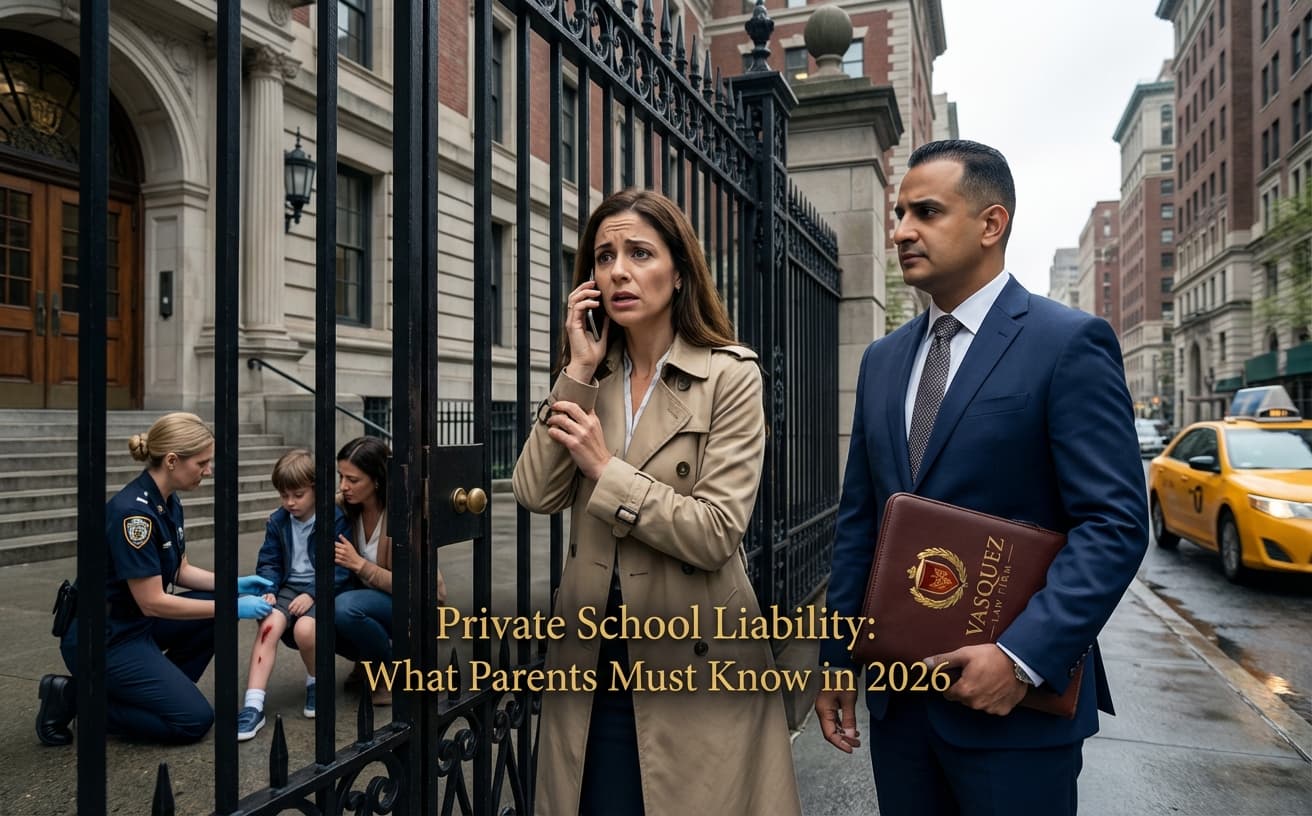
Understanding private school liability is crucial for parents, especially when considering the safety and well-being of their children. In 2026, private schools, much like public institutions, owe a duty of care to their students, meaning they must take reasonable steps to prevent foreseeable harm. If a child suffers an injury due to negligence, the school or its employees may be held liable. Navigating these complex legal waters requires a clear understanding of the laws in North Carolina and Florida, where Vasquez Law Firm assists families in Orlando and across both states.
Need help with your case? Our experienced attorneys are ready to fight for you. Se Habla Español.
Schedule Your Free Case Evaluation
Or call us now: 1-844-967-3536
Quick Answer
Private school liability refers to the legal responsibility private schools hold for the safety and well-being of their students. This typically involves negligence, where a school fails to exercise reasonable care, leading to student injury. Liability can arise from inadequate supervision, unsafe premises, or negligent hiring, and the specific laws governing these cases can vary significantly between North Carolina and Florida.
- Schools must provide reasonable supervision.
- Premises must be kept safe and hazard-free.
- Negligent hiring or retention can lead to liability.
- Victims must prove the school's negligence caused the injury.
- State laws in NC and FL dictate specific legal standards.
Understanding Private School Liability in 2026
Private school liability is a critical area of personal injury law that addresses a school's legal responsibility for harm suffered by its students. Unlike public schools, which often have governmental immunity, private schools are typically treated more like private corporations under the law. This means they can be sued for negligence, breach of contract, or other torts if their actions, or inactions, lead to a student's injury or harm.
The core principle revolves around the 'duty of care' that a private school owes to its students. This duty requires schools to act reasonably to protect students from foreseeable dangers. For example, ensuring proper supervision during activities, maintaining safe facilities, and employing qualified staff are all aspects of this duty. When a school fails in this duty and a student is harmed as a direct result, a claim for private school liability may arise.
Proving private school liability often involves demonstrating four key elements: duty, breach, causation, and damages. First, the school must have owed a duty of care to the student. Second, the school must have breached that duty, meaning they failed to act as a reasonably prudent school would under similar circumstances. Third, this breach must have been the direct cause of the student's injury. Finally, the student must have suffered actual damages, such as medical expenses, pain and suffering, or lost educational opportunities. Understanding these elements is essential for anyone considering a claim related to private school liability in 2026.
Recent cases, such as the tragic incident where a student was fatally crushed between cars in a school parking lot, highlight the severe consequences when a private school's duty of care is allegedly breached. These incidents underscore the importance of robust safety protocols and vigilant supervision. Parents often entrust private schools with the safety of their children, expecting a high standard of care. When that trust is broken due to negligence, legal recourse may be necessary to ensure accountability and prevent future harm.
Common Types of Private School Negligence
Private school liability can stem from various forms of negligence. One common area is inadequate supervision. Schools have a responsibility to provide appropriate supervision for students during school hours, extracurricular activities, and even during transportation arranged by the school. If a student is injured because there weren't enough supervisors, or the supervisors were not attentive, the school could be held liable.
Another significant factor is unsafe premises. Private schools must maintain their facilities in a safe condition, free from hazards that could foreseeably injure students. This includes ensuring playgrounds are properly maintained, classrooms are safe, hallways are clear, and sports equipment is functional. For instance, a broken swing set, a slippery floor without warning signs, or inadequate security measures could all lead to a claim of private school liability if an injury occurs.
Negligent hiring or retention is also a serious concern. Schools are expected to conduct thorough background checks on all employees, including teachers, coaches, and administrative staff. If a school hires or continues to employ an individual with a history of misconduct or who poses a risk to students, and that individual harms a student, the school may be held liable. This extends to failing to act on complaints or suspicions about an employee's behavior, thereby creating a dangerous environment for students.
Furthermore, negligence can arise from a school's failure to address bullying, provide proper medical care, or implement appropriate safety protocols during school events or field trips. Each of these situations represents a potential breach of the school's duty of care. Parents in Orlando and across North Carolina and Florida must understand these potential areas of negligence to protect their children's rights when considering private school liability claims.
Step-by-Step: What to Do After a School Injury
If your child is injured at a private school, taking immediate and systematic steps is crucial to protect their well-being and any potential legal claim. First, ensure your child receives immediate medical attention. Their health is the top priority. Document all medical care, diagnoses, and treatments received, as these records will be vital for any future private school liability claim.
Next, report the incident to the school administration in writing as soon as possible. This creates an official record of the injury and the circumstances surrounding it. Be sure to include details such as the date, time, location, and a brief description of what happened. Request a copy of their incident report if one is created. Do not make any statements admitting fault or minimizing the injury.
Gather evidence at the scene if possible and safe to do so. This includes taking photos or videos of the injury, the area where it occurred, and any potential hazards. Talk to any witnesses and obtain their contact information. Preserve any clothing or items that might have been damaged or could serve as evidence. This proactive evidence collection is critical for building a strong case for private school liability.
Finally, contact an experienced personal injury attorney promptly. An attorney specializing in private school liability can guide you through the complexities of the legal process, help you understand your rights, and assess the viability of your claim. They can also handle communications with the school and their insurance companies, ensuring your child's best interests are represented. Early legal counsel is essential, especially in North Carolina and Florida, where specific statutes of limitations apply to such cases.
Documents and Evidence Checklist for a Claim
Building a strong case for private school liability requires comprehensive documentation. Having an organized collection of evidence can significantly impact the success of your claim. Here is a checklist of essential documents and evidence to gather:
- Medical Records: All reports, diagnoses, treatment plans, and bills related to your child's injury. This includes emergency room visits, specialist consultations, therapy notes, and prescription records.
- School Incident Reports: Any official reports filed by the school regarding the incident. Ensure you have requested and received a copy of these.
- Photos and Videos: Visual evidence of the injury, the accident scene, any hazardous conditions, and damaged property. Timestamped media is highly valuable.
- Witness Statements: Contact information and written statements from anyone who saw the incident or has relevant information.
- Communication Records: Copies of all emails, letters, and other correspondence with the school administration, teachers, or staff regarding the incident and your child's care.
- School Policies and Procedures: Relevant sections of the school's handbook, safety guidelines, and supervision policies. These can show what duty of care the school explicitly committed to.
- Attendance and Academic Records: Documentation showing how the injury impacted your child's attendance, academic performance, or participation in school activities.
- Parental Expenses: Records of any out-of-pocket expenses incurred, such as travel for medical appointments, lost wages due to caring for your child, or costs for specialized care.
- Journal or Diary: A personal record detailing your child's pain, suffering, emotional distress, and daily challenges since the injury. This can help illustrate non-economic damages.
Collecting these items diligently will provide a robust foundation for pursuing a private school liability claim. An attorney can help you identify any missing pieces and ensure all evidence is properly compiled and presented.
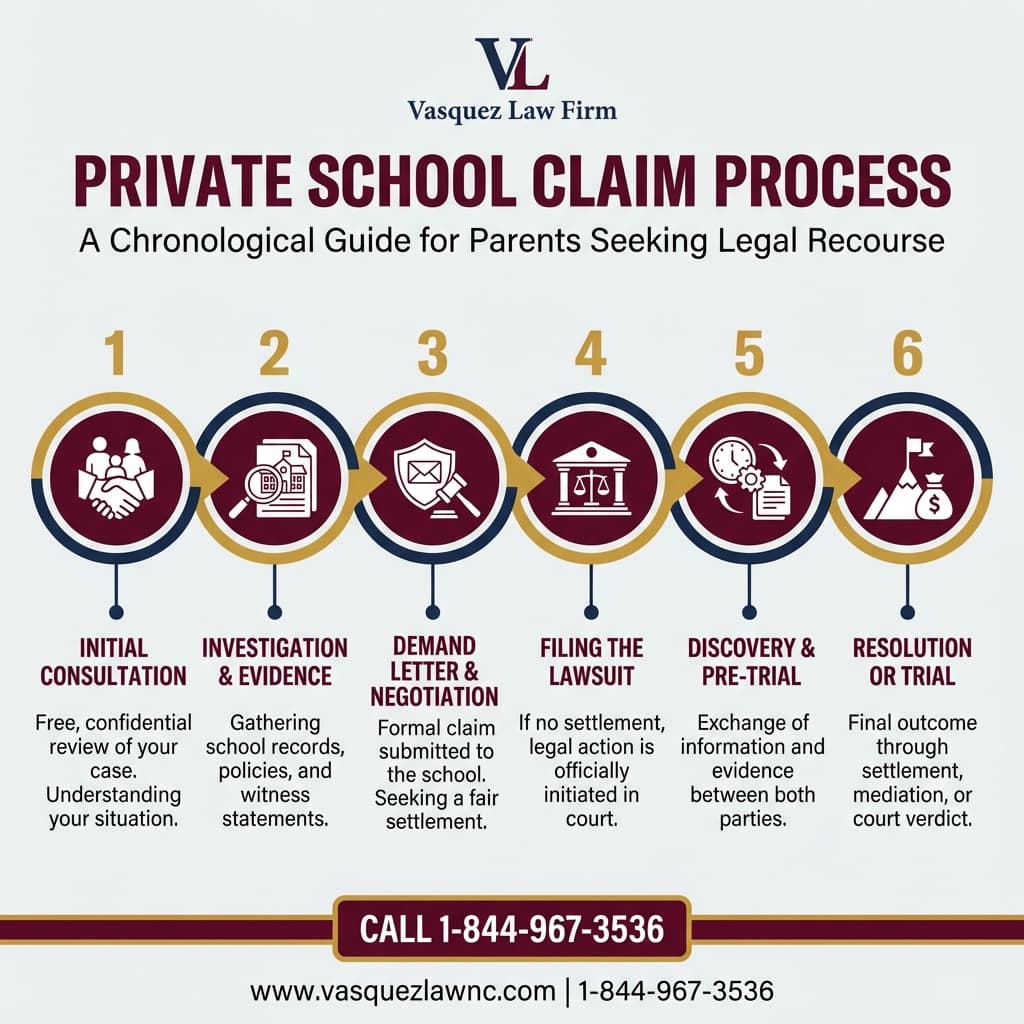
Timeline: What to Expect in a Private School Liability Case
The timeline for a private school liability case can vary significantly depending on the complexity of the injury, the school's response, and the jurisdiction (North Carolina or Florida). Generally, these cases proceed through several distinct stages, each with its own timeframe.
- Immediate Aftermath (Days to Weeks): This period involves getting medical attention for your child, reporting the incident to the school, and beginning to gather initial evidence. An attorney should be contacted during this phase to preserve evidence and advise on initial steps.
- Investigation and Demand (1-3 Months): Your attorney will conduct a thorough investigation, collecting all medical records, witness statements, and school policies. A demand letter outlining the school's negligence and your damages will typically be sent to the school's insurance company.
- Negotiation (2-6 Months): After receiving the demand letter, the school's insurance company will review the claim and may offer a settlement. Negotiations can be lengthy, with multiple rounds of offers and counter-offers. This stage aims to reach a fair settlement without litigation.
- Filing a Lawsuit (If Necessary, 6-12 Months from Incident): If negotiations fail to yield a satisfactory settlement, your attorney may recommend filing a formal lawsuit. This marks the beginning of the litigation process. It's crucial to be aware of the statute of limitations, which in North Carolina, for most personal injury claims, is generally three years from the date of injury (N.C. Gen. Stat. § 1-52). In Florida, it's typically two years (Florida Statutes § 95.11(3)(a)).
- Discovery Phase (6-18 Months Post-Lawsuit): This is an extensive information-gathering stage where both sides exchange documents, conduct depositions (sworn testimonies), and interview witnesses. This phase can be time-consuming due to its thorough nature.
- Mediation/Arbitration (Optional, During Discovery): Many courts require or encourage alternative dispute resolution methods like mediation or arbitration to try and settle the case before trial.
- Trial (If No Settlement, 1-2+ Years Post-Lawsuit): If the case doesn't settle, it will proceed to trial. A trial can last anywhere from a few days to several weeks, depending on the complexity. After the trial, there may be an appeals process.
This timeline highlights the importance of early action and consistent legal guidance throughout the private school liability process.
Costs and Fees: What Impacts the Price of a Claim
The financial aspect of pursuing a private school liability claim is a common concern for parents. Understanding how costs and fees are structured can help manage expectations. Many personal injury attorneys, including Vasquez Law Firm, work on a contingency fee basis. This means you don't pay any upfront legal fees. Instead, the attorney's fee is a percentage of the final settlement or court award. If you don't win, you don't pay attorney fees.
Several factors can influence the overall cost of a private school liability case. The complexity of the case plays a significant role; more intricate cases involving extensive investigations, numerous witnesses, or highly specialized medical evidence may incur higher costs. The severity of your child's injuries and the extent of their damages also impact potential settlement values, which in turn affects the attorney's contingency fee.
Court costs and litigation expenses are separate from attorney fees. These can include filing fees, court reporter fees for depositions, expert witness fees, and costs for obtaining medical records. While your attorney's fee is contingent, you may be responsible for these expenses regardless of the outcome, though many firms advance these costs and only seek reimbursement from a successful settlement or award. It is crucial to have a clear discussion with your attorney about how these expenses are handled.
The need for expert witnesses, such as medical professionals or school safety experts, can also add to the costs. These experts provide crucial testimony to establish the extent of injuries or to demonstrate how the school's actions deviated from accepted safety standards. The length of the legal process, from initial investigation to potential trial, also contributes to overall expenses. A longer, more contested case will naturally accrue more costs. A lawyer experienced in private school liability can provide a realistic estimate of these potential expenses.
Common Mistakes and How to Avoid Them
Navigating a private school liability claim can be challenging, and certain missteps can jeopardize your case. Being aware of these common mistakes can help you protect your child's rights and strengthen your claim.
- Delaying Medical Attention: One of the biggest mistakes is not seeking immediate medical care. Delays can worsen your child's condition and make it harder to prove a direct link between the injury and the school's negligence. Always prioritize prompt medical evaluation.
- Not Reporting the Incident Promptly: Failing to report the injury to school administration in writing can weaken your claim. Without an official record, the school may later deny knowledge of the incident or its specifics.
- Discussing the Case on Social Media: Anything you post online can be used against you. Avoid discussing the incident, your child's injuries, or the legal process on social media platforms.
- Accepting an Early Settlement Offer: Insurance companies often try to settle quickly for a low amount before the full extent of damages is known. Never accept an offer without consulting an attorney, as it may be far less than your child deserves.
- Failing to Gather Evidence: Not collecting photos, witness information, or other relevant evidence at the scene can be a critical error. Memories fade, and conditions change, so immediate documentation is vital.
- Misrepresenting Facts: Always be honest and accurate in all communications with medical professionals, school officials, and your attorney. Inconsistencies can severely damage your credibility.
- Missing Legal Deadlines (Statute of Limitations): There are strict time limits (statutes of limitations) for filing personal injury claims. Missing these deadlines, which vary by state (e.g., North Carolina and Florida), will likely result in your case being dismissed permanently.
- Speaking Directly with the School's Insurer: The school's insurance company is not on your side. Their goal is to minimize their payout. Let your attorney handle all communications to protect your interests.
- Not Consulting a Qualified Attorney: Trying to navigate the complexities of private school liability law alone is a significant mistake. An experienced attorney understands the nuances, can value your claim accurately, and will fight for maximum compensation.
If you only remember one thing: Always prioritize your child's medical care, document everything, and seek legal counsel immediately to avoid critical errors in a private school liability case.
North Carolina and Nationwide Notes
While the general principles of private school liability are similar across the United States, specific laws and precedents can vary significantly between North Carolina and Florida. Understanding these differences is crucial for anyone pursuing a claim in either state. Vasquez Law Firm serves clients in both jurisdictions, offering tailored legal guidance based on state-specific regulations.
North Carolina Notes on Private School Liability
In North Carolina, private schools generally do not benefit from sovereign immunity, meaning they can be sued like any other private entity for negligence. The standard of care required of schools is typically that of a reasonably prudent person under similar circumstances. This involves providing adequate supervision, maintaining safe premises, and exercising care in hiring and retaining staff. North Carolina law (N.C. Gen. Stat. § 1-52) sets a three-year statute of limitations for most personal injury claims, including those against private schools, from the date of the injury. This means you must file a lawsuit within three years, or you risk losing your right to pursue compensation. Additionally, North Carolina follows the doctrine of contributory negligence, which can be a significant hurdle. If the injured party (your child) is found to be even 1% at fault for their injuries, they may be barred from recovering any damages. This makes proving sole negligence on the part of the school even more critical in NC cases.
Nationwide Concepts (General Only, Rules Vary)
Across the United States, the fundamental concept of private school liability rests on the school's duty of care to its students. While specific statutes of limitations, doctrines of negligence (contributory vs. comparative), and premises liability laws vary from state to state, the core expectation is that schools will act reasonably to ensure student safety. This includes preventing foreseeable harm, providing adequate supervision, and maintaining safe environments. Generally, private schools are not protected by sovereign immunity, making them more susceptible to negligence claims than their public counterparts. The legal standard for negligence almost universally requires proving duty, breach, causation, and damages. However, the exact interpretation and application of these elements can differ. Always remember that legal outcomes are highly dependent on the specific state laws where the incident occurred. Consulting with an attorney licensed in that specific state is always the best course of action to understand the local nuances of private school liability.
When to Call a Lawyer Now About Private School Liability
Recognizing when to contact a lawyer is crucial for protecting your child's rights and ensuring accountability in a private school liability case. Don't delay seeking legal counsel if any of these situations apply to your child's injury:
- Your child has suffered a serious injury requiring extensive medical treatment or hospitalization.
- The school is denying responsibility or blaming your child for the incident.
- The school's insurance company has contacted you directly and is pressuring you to accept a quick settlement.
- The school is not cooperating with your requests for information or incident reports.
- There is evidence of inadequate supervision, unsafe conditions, or negligent hiring/retention practices.
- Your child's injury has resulted in significant medical bills, lost wages for you, or long-term physical or emotional trauma.
- The incident involves allegations of abuse or intentional harm by a school employee or another student that the school failed to prevent.
- You are concerned about the statute of limitations running out, especially in Florida where the period is shorter.
- You need help understanding your rights and options under North Carolina or Florida law.
If you find yourself in any of these situations, contacting an experienced personal injury attorney from Vasquez Law Firm immediately is essential. We can help you navigate the complexities of private school liability and fight for the justice your family deserves.
About Vasquez Law Firm
At Vasquez Law Firm, we combine compassion with aggressive representation. Our motto "Yo Peleo" (I Fight) reflects our commitment to standing up for your rights. We understand the physical, emotional, and financial toll an injury can take on a family, especially when it involves a child. Our dedicated team is here to provide unwavering support and fierce advocacy for clients navigating complex legal matters, including those related to private school liability.
- Bilingual Support: Se Habla Español - our team is fully bilingual, ensuring clear communication and culturally sensitive representation for all our clients.
- Service Areas: Personal injury in North Carolina; immigration nationwide, including Florida
- Experience: With over 15 years of dedicated legal experience, Attorney Vasquez has a proven track record of helping clients achieve favorable outcomes in personal injury, immigration, workers' compensation, and criminal defense cases.
- Results: Our firm is committed to achieving the best possible results for our clients, having secured thousands of successful outcomes across multiple practice areas. We fight tirelessly to ensure justice is served.
Attorney Trust and Experience
Attorney Vasquez holds a Juris Doctor degree and is admitted to practice in both the North Carolina State Bar and Florida Bar. With over 15 years of dedicated legal experience, he has built a reputation for providing personalized attention and achieving favorable outcomes for his clients. His commitment to justice and his clients' well-being drives every case he handles. Attorney Vasquez understands the emotional stakes involved in cases of private school liability and approaches each situation with empathy and strategic determination.
Don't face your legal challenges alone. Our team is here to help you every step of the way.
Call today: 1-844-967-3536 | Se Habla Español
Frequently Asked Questions
Do private schools have liability insurance?
Yes, most private schools carry comprehensive liability insurance policies to protect themselves against claims of negligence, injury, or other harm to students, visitors, or staff. This insurance covers legal defense costs and potential settlements or judgments. However, the existence of insurance doesn't automatically mean a claim will be paid; negligence must still be proven according to state law, which can vary between North Carolina and Florida.
What is the biggest issue in private schools regarding safety?
While many issues exist, a significant safety concern in private schools often revolves around ensuring adequate supervision and maintaining safe facilities. These are broad categories that can encompass everything from playground safety to preventing bullying or responding effectively to emergencies. The challenge lies in consistently upholding a high duty of care across all activities and environments, especially with varying student-to-staff ratios and diverse facilities.
Can a private school be sued for a student's injury?
Yes, a private school can absolutely be sued for a student's injury if negligence can be proven. Unlike public schools that often benefit from governmental immunity, private schools are typically treated as private entities under the law. This means they are subject to personal injury lawsuits if their failure to exercise reasonable care directly leads to a student's harm, whether in North Carolina or Florida.
Who is responsible if my child gets hurt at school?
Responsibility for a child's injury at school depends on the circumstances. If the injury resulted from the school's negligence (e.g., inadequate supervision, unsafe premises, faulty equipment), the school could be held liable. However, if the injury was an unavoidable accident or resulted from the child's own actions or another student's actions without the school's foreseeable negligence, responsibility might be more complex. An investigation is typically required.
What is the duty of care for private schools?
The duty of care for private schools requires them to act as a reasonably prudent institution would under similar circumstances to protect students from foreseeable harm. This includes providing adequate supervision, maintaining safe premises, implementing reasonable safety protocols, and exercising care in hiring and retaining staff. Breaching this duty can lead to private school liability if it directly causes a student's injury.
How long do I have to file a lawsuit against a private school?
The time limit for filing a lawsuit, known as the statute of limitations, varies by state. In North Carolina, it's generally three years from the date of injury (N.C. Gen. Stat. § 1-52). In Florida, it's typically two years (Florida Statutes § 95.11(3)(a)). It is critical to consult an attorney quickly to ensure you meet these deadlines, as missing them can permanently bar your claim.
What damages can I claim in a private school liability case?
In a private school liability case, you can typically claim both economic and non-economic damages. Economic damages include medical expenses (past and future), lost wages (if a parent missed work to care for the child), and educational support. Non-economic damages cover pain and suffering, emotional distress, loss of enjoyment of life, and disfigurement. The specific types and amounts of damages depend on the severity of the injury and state laws.
What if my child was partially at fault for the injury?
If your child was partially at fault, the impact on your claim depends on the state's negligence laws. North Carolina follows contributory negligence, meaning if your child is found even 1% at fault, you may recover nothing. Florida, however, uses pure comparative negligence, allowing recovery reduced by the child's percentage of fault. An attorney can assess how this applies to your specific private school liability case.
Can I sue a private school for bullying?
You may be able to sue a private school for bullying if the school's negligence contributed to the harm. This typically involves demonstrating that the school was aware of the bullying, failed to take reasonable steps to prevent or stop it, and this failure directly led to your child's injury or emotional distress. Proving such a claim requires careful documentation of the bullying incidents and the school's response.
How can an attorney help with a private school liability claim?
An attorney specializing in private school liability can provide invaluable assistance by investigating the incident, gathering evidence, identifying responsible parties, and negotiating with the school's insurance company. They understand complex state laws, like those in North Carolina and Florida, and can accurately value your claim, ensuring you seek fair compensation for medical bills, pain and suffering, and other damages. An attorney will advocate for your child's rights every step of the way.
Sources and References
- North Carolina Courts
- North Carolina Department of Transportation (NCDOT)
- Florida Statutes § 95.11(3)(a) - Limitations of actions
- N.C. Gen. Stat. § 1-52 - Periods of limitation generally
Injured? Our personal injury attorneys can review your claim.
Ready to take the next step? Contact Vasquez Law Firm today for a free, confidential consultation. We're committed to fighting for your rights and achieving the best possible outcome for your case.
Start Your Free Case Evaluation Now
Call us: 1-844-967-3536
Se Habla Español - Estamos aquí para ayudarle.
William Vasquez
Founder & CEO, Vasquez Law Firm, PLLC
William Vasquez is the founder and CEO of Vasquez Law Firm, PLLC, a results-driven firm specializing in immigration, criminal defense, personal injury, and workers' compensation. A U.S. Air Force veteran and recipient of the Joint Service Achievement Medal, William is dedicated to fiercely fighting for his clients' rights.
Related Legal Services
Need legal help? Learn more about our personal injury law practice, or contact us for a free evaluation.
You can also visit our NC injury attorneys for more information.