How to Get Workers Comp for a Traumatic Brain Injury in 2026
Suffered a traumatic brain injury at work? Understand your workers' comp rights in 2026. Get expert help with your claim. Contact Vasquez Law for a free consultation today.
Published on February 23, 2026
Hurt on the job?
Free review of your workers' comp claim.
Free & confidential · Se habla espanol · 24/7

Have questions? Talk to an attorney - free evaluation.
Call 1-844-967-3536Hurt on the Job? Claim What You Are Owed
A review of your workers' comp claim - we handle the fight.
How to Get Workers Comp for a Traumatic Brain Injury in 2026
A traumatic brain injury (TBI) can be one of the most devastating consequences of a workplace accident, leading to profound physical, cognitive, and emotional challenges. If you've suffered a TBI on the job, navigating the workers' compensation system to secure the benefits you deserve can feel overwhelming. This comprehensive guide for 2026 breaks down the complexities of a traumatic brain injury workers' comp claim, explaining what you need to know to protect your rights and access critical medical care and financial support. Understanding the unique aspects of TBI claims, from initial reporting to long-term care, is crucial for a successful outcome.
Need help with your traumatic brain injury workers' comp case? Our experienced attorneys are ready to fight for you. Se Habla Español.
Schedule Your Free Case Evaluation
Or call us now: 1-844-967-3536
Quick Answer
A traumatic brain injury workers' comp claim in North Carolina or Florida involves proving the injury occurred at work, documenting its severity, and linking it to your job duties to secure benefits for medical treatment, lost wages, and rehabilitation. These claims are complex and often require extensive medical evidence and legal advocacy to ensure fair compensation and long-term care.
- Report the injury immediately to your employer.
- Seek prompt medical attention from specialists.
- Document all symptoms, treatments, and their impact.
- Consult with an experienced workers' comp attorney.
- Understand the unique long-term implications of TBI.
Understanding Traumatic Brain Injury Workers' Comp Claims
Traumatic brain injuries (TBIs) range from mild concussions to severe, life-altering damage. When these injuries occur in the workplace, they fall under workers' compensation laws, which are designed to provide injured employees with benefits regardless of fault. However, the nature of TBI makes these claims particularly challenging, as symptoms can be subtle, delayed, or misunderstood.
Unlike a broken bone, a TBI may not have immediate visible signs, but its effects can be profound and long-lasting. These can include cognitive impairments like memory loss, difficulty concentrating, mood swings, headaches, and sensitivity to light and sound. The insidious nature of TBI symptoms often leads to disputes with insurance companies who may question the severity or work-relatedness of the injury, making legal representation essential for a successful workers' compensation claim.
Successfully navigating a traumatic brain injury workers' comp claim requires meticulous documentation, expert medical opinions, and a thorough understanding of state-specific workers' compensation statutes. Insurance carriers often try to minimize payouts for TBIs due to the potential for expensive, lifelong care and extensive lost wage benefits. This is why having a dedicated advocate from Vasquez Law Firm is crucial to ensure your rights are protected and you receive the full scope of benefits you are entitled to in 2026.
Classifying TBI Severity and Its Impact on Workers' Comp
The severity of a traumatic brain injury significantly impacts the scope and duration of workers' comp benefits. TBIs are generally classified as mild, moderate, or severe, based on factors like loss of consciousness, post-traumatic amnesia, and Glasgow Coma Scale (GCS) scores. Each classification presents unique challenges in a workers' compensation claim.
Mild TBIs, often referred to as concussions, can be difficult to diagnose and may not immediately seem serious. However, even a mild TBI can lead to post-concussion syndrome, causing persistent headaches, dizziness, and cognitive issues that prevent a worker from returning to their job. Moderate and severe TBIs involve more significant brain damage, often resulting in long-term or permanent disability, requiring extensive rehabilitation, and potentially lifelong medical care.
Insurance companies frequently downplay mild TBIs or argue that symptoms are not work-related. For moderate to severe cases, they may dispute the extent of disability or the need for specific treatments. Accurate diagnosis by neurologists and other specialists, along with detailed medical records, is paramount. These records help establish the direct link between the workplace accident and the traumatic brain injury, justifying the need for comprehensive benefits, including vocational rehabilitation and long-term care planning.
Steps to Take After a Workplace Traumatic Brain Injury
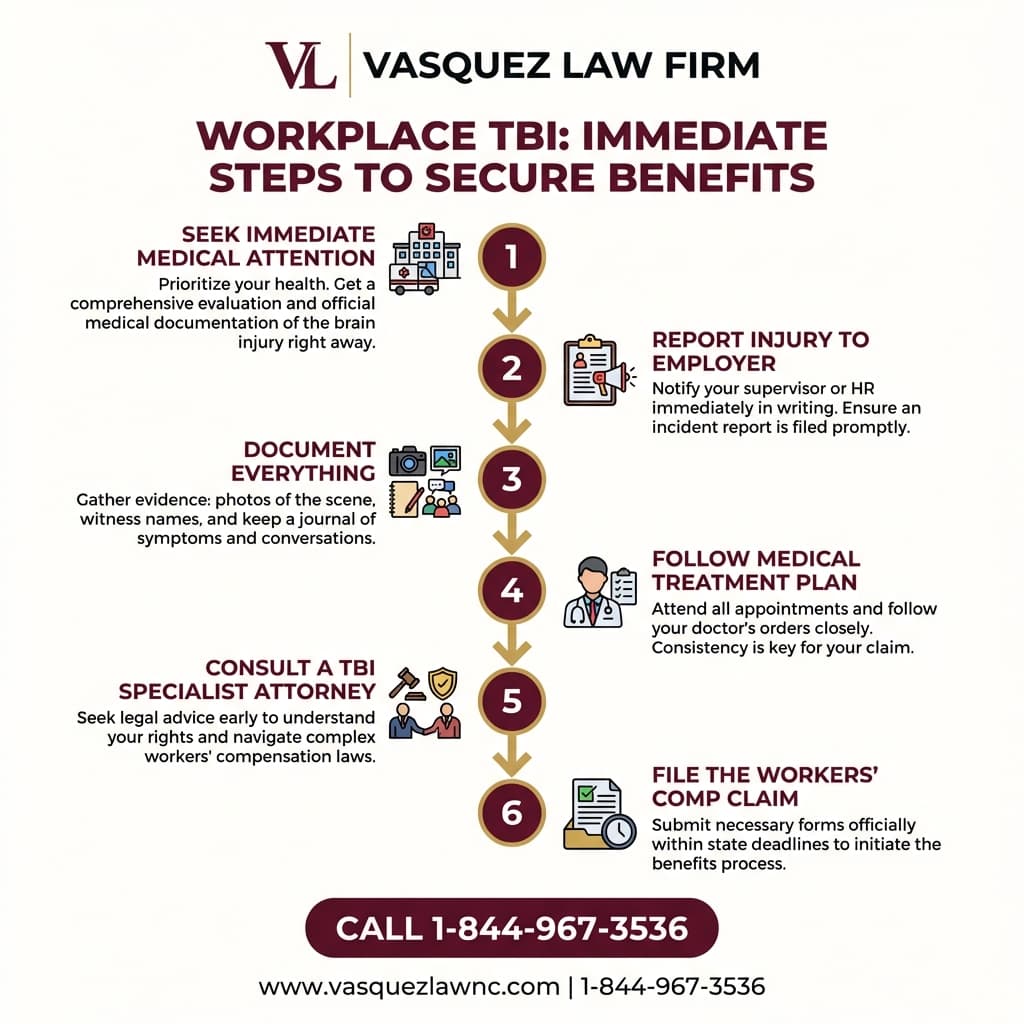
Immediate and decisive action after a workplace TBI is critical for your health and the success of your workers' comp claim. Following these steps can help protect your rights and ensure you receive proper medical care and benefits.
Report the Injury Immediately
Notify your employer in writing as soon as possible, ideally within 30 days in North Carolina and Florida. Clearly state that you sustained a head injury or suspect a concussion. Delayed reporting can jeopardize your claim, as insurance companies may argue the injury wasn't work-related. Include the date, time, and circumstances of the accident.
Seek Prompt Medical Attention
Even if you feel fine, see a doctor immediately. TBI symptoms can be delayed or subtle. A medical professional, especially one experienced in brain injuries, can properly diagnose your condition and begin a treatment plan. Follow all medical advice and attend every appointment. This creates a crucial record of your North Carolina Industrial Commission claim.
Document Everything
Keep a detailed journal of your symptoms, medical appointments, medications, and how the injury impacts your daily life. Save all medical bills, receipts, and communications with your employer or the insurance company. This comprehensive documentation provides compelling evidence for your traumatic brain injury workers' comp case.
Consult a Workers' Comp Attorney
TBI claims are exceptionally complex. An attorney specializing in workers' comp, such as Attorney Vasquez from Vasquez Law Firm, can guide you through the process, help gather evidence, negotiate with insurance companies, and represent you in hearings. This early intervention can significantly improve your chances of a fair settlement or award.
Proving Your Traumatic Brain Injury Workers' Comp Claim
Establishing a successful traumatic brain injury workers' comp claim requires robust evidence linking your injury to your employment. This can be particularly challenging with TBIs due to their often invisible nature and the potential for delayed symptoms. You must demonstrate that the injury arose out of and in the course of your employment.
Key evidence includes detailed accident reports, witness statements, and most importantly, comprehensive medical documentation. This includes neurological evaluations, imaging tests like CT scans or MRIs (though these may not always show mild TBI), neuropsychological assessments, and ongoing treatment records from specialists. These records must clearly outline the diagnosis, prognosis, and the causal connection between the workplace incident and your TBI. Causation is a critical legal element to prove.
Insurance companies may request an independent medical examination (IME) or challenge the severity of your injury. An experienced attorney can help counter these tactics by presenting compelling evidence and expert testimony. They can also ensure that all potential benefits, including temporary and permanent disability, medical expenses, and vocational rehabilitation, are pursued vigorously. The goal is to secure compensation that accurately reflects the long-term impact of your traumatic brain injury.
Workers' Compensation Benefits for Traumatic Brain Injuries
If your traumatic brain injury workers' comp claim is approved, you are entitled to several types of benefits designed to support your recovery and compensate for losses. These benefits are crucial for managing the significant costs associated with TBI care and recovery.
Medical Treatment
Workers' comp covers all necessary medical expenses related to your TBI, including emergency care, doctor visits, specialist consultations (neurologists, neuropsychologists), physical therapy, occupational therapy, speech therapy, medication, and assistive devices. This can extend to long-term rehabilitation and ongoing care for chronic symptoms. It is vital to continue treatment as recommended by your doctors.
Lost Wages (Disability Benefits)
If your TBI prevents you from working, you may be eligible for temporary disability benefits, which typically cover a percentage of your average weekly wages. For severe TBIs leading to permanent impairment, you might receive permanent partial disability (PPD) or permanent total disability (PTD) benefits. These benefits are essential for maintaining financial stability when you cannot perform your job duties.
Vocational Rehabilitation
For those unable to return to their previous job due to a TBI, workers' comp may cover vocational rehabilitation services. This can include job retraining, skill development, and assistance in finding suitable alternative employment. The goal is to help injured workers re-enter the workforce in a capacity appropriate for their post-injury capabilities.
NC, FL, and Nationwide Notes for TBI Workers' Comp
Workers' compensation laws are state-specific, meaning the rules and benefits for a traumatic brain injury workers' comp claim can vary significantly depending on where your injury occurred. Understanding these distinctions is vital.
NC Notes
In North Carolina, the NC Industrial Commission oversees workers' compensation claims. You must report your injury to your employer within 30 days and file a Form 18 or 18B (for occupational disease) with the Industrial Commission within two years. North Carolina law provides for medical treatment, temporary disability benefits (two-thirds of your average weekly wage, up to a state maximum), and permanent disability benefits. TBI claims often involve extensive litigation over the extent of impairment and the need for long-term care. Vasquez Law Firm has extensive experience with NC workers' compensation law, including complex TBI cases in areas like Smithfield and across the state.
FL Notes
Florida's workers' compensation system is administered by the Florida Department of Financial Services, Division of Workers' Compensation. Employers typically have 7 days to report an injury to their carrier, and you generally have 30 days to report it to your employer. Florida law also provides for medical benefits and wage loss benefits, usually at 66 2/3% of your average weekly wage. Florida places a strong emphasis on employer-directed medical care, which can be challenging for TBI patients who may need highly specialized care. Navigating these requirements, especially for a severe traumatic brain injury, requires skilled legal counsel. Vasquez Law Firm assists clients throughout Florida with their workers' comp claims.
Nationwide Concepts (General Only, Rules Vary)
While specific rules vary by state, some general concepts apply across most workers' compensation systems in the U.S. All states require prompt reporting of injuries and provide benefits for medical care and lost wages. However, the duration of benefits, choice of doctor, and methods for calculating permanent disability differ. The unique challenge of TBI claims, involving often invisible injuries and long-term implications, necessitates expert medical evidence and legal advocacy, regardless of the state. Always consult with an attorney licensed in the state where your injury occurred to understand the precise rules governing your traumatic brain injury workers' comp claim.
When to Call a Lawyer for Your Traumatic Brain Injury Workers' Comp Claim
A traumatic brain injury is not just another injury; it's a life-altering event that demands specialized legal attention. Don't wait until it's too late to get the help you need. You should contact a qualified workers' compensation attorney immediately if:
- Your employer denies your claim or disputes the work-relatedness of your TBI.
- The insurance company tries to minimize your injury or pushes you to return to work too soon.
- You are offered a settlement that seems too low or doesn't account for long-term care.
- You are having difficulty getting approval for necessary medical treatments or specialists.
- Your doctor recommends treatments or rehabilitation that the insurance company refuses to cover.
- You are experiencing severe or worsening symptoms that impact your ability to work or live independently.
- You are unsure about your rights or the complex legal process of a traumatic brain injury workers' comp claim.
- You face a permanent disability rating and need to understand your options for future benefits.
Don't face your legal challenges alone. Our team is here to help you every step of the way.
Call today: 1-844-967-3536 | Se Habla Español
About Vasquez Law Firm
At Vasquez Law Firm, we combine compassion with aggressive representation, especially for victims of serious workplace injuries like traumatic brain injuries. Our motto "Yo Peleo" (I Fight) reflects our unwavering commitment to standing up for your rights and securing the justice and compensation you deserve.
- Bilingual Support: Se Habla Español - our team is fully bilingual, ensuring clear communication and understanding.
- Service Areas: Workers compensation in North Carolina; immigration nationwide, including Florida
- Experience: With over 15 years of focused experience, we have successfully navigated complex legal matters for thousands of clients.
- Results: Our track record demonstrates our ability to achieve favorable outcomes across multiple practice areas, including challenging TBI cases.
Attorney Trust and Experience
Attorney Vasquez holds a Juris Doctor degree and is admitted to practice in both the North Carolina State Bar and Florida Bar. With over 15 years of dedicated legal experience, he has built a reputation for providing personalized attention and achieving favorable outcomes for his clients, particularly in demanding workers' compensation cases involving severe injuries like traumatic brain injuries. He understands the profound impact a TBI can have on an individual and their family, and he is committed to fighting tirelessly on their behalf.
Frequently Asked Questions
Is a traumatic brain injury considered a lifelong disability?
A traumatic brain injury can certainly result in a lifelong disability, especially if it is moderate to severe. Many TBI survivors experience chronic cognitive, physical, and emotional challenges that impact their ability to work, learn, and perform daily activities. While some recover fully, others face permanent impairments requiring ongoing medical care and support, which workers' comp should cover.
What is the average payout for a traumatic brain injury workers' comp settlement?
There is no "average" payout for a traumatic brain injury workers' comp settlement, as each case is unique. Settlements depend heavily on the severity of the injury, medical expenses incurred, projected future care costs, lost wages, and the specific state's workers' compensation laws. Severe TBIs with lifelong implications typically result in higher settlements to cover extensive long-term care and lost earning capacity.
What are the criteria for a traumatic brain injury diagnosis?
The criteria for a TBI diagnosis typically involve evidence of impact to the head, followed by an alteration in brain function. This can include loss of consciousness, post-traumatic amnesia, disorientation, or neurological deficits. Doctors use clinical assessments, Glasgow Coma Scale (GCS) scores, and sometimes imaging tests like CT or MRI scans, along with neuropsychological evaluations, to confirm the diagnosis and assess severity.
How long does it take to recover from a traumatic brain injury?
Recovery from a traumatic brain injury varies significantly. Mild TBIs (concussions) may resolve within weeks or months, though some can lead to persistent post-concussion syndrome. Moderate to severe TBIs often require months or even years of intensive rehabilitation, and some individuals may never fully recover, facing permanent impairments. The recovery timeline depends on injury severity, age, overall health, and access to effective treatment.
Can I return to work after a traumatic brain injury?
Returning to work after a traumatic brain injury depends on the injury's severity and the demands of your job. Many with mild TBIs can return, often with accommodations or a gradual return-to-work plan. Those with moderate to severe TBIs may require vocational rehabilitation, job retraining, or may be unable to return to their previous occupation. Your doctor's clearance and functional capacity evaluations are crucial.
What if my employer denies my TBI workers' comp claim?
If your employer or their insurance company denies your traumatic brain injury workers' comp claim, do not give up. You have the right to appeal the decision. This process typically involves filing specific forms, attending hearings, and presenting evidence to support your claim. Consulting an experienced workers' comp attorney immediately is vital to navigate the appeal process successfully and protect your rights.
Are concussions covered under workers' compensation?
Yes, concussions are generally covered under workers' compensation if they are sustained as a result of a workplace accident or incident. A concussion is a form of mild traumatic brain injury (TBI). Even if symptoms seem minor initially, it is crucial to report the injury and seek medical attention promptly, as post-concussion syndrome can lead to prolonged disability and require extensive treatment.
What types of medical specialists treat traumatic brain injuries?
Treating traumatic brain injuries often requires a multidisciplinary team of medical specialists. This can include neurologists, neuropsychologists, physiatrists (rehabilitation physicians), physical therapists, occupational therapists, speech-language pathologists, and mental health professionals. The specific team depends on the nature and severity of the TBI and the individual's specific symptoms and rehabilitation needs.
How long do I have to file a traumatic brain injury workers' comp claim in NC?
In North Carolina, you generally have two years from the date of your traumatic brain injury to file a formal claim with the North Carolina Industrial Commission. However, you must notify your employer in writing of your injury within 30 days of the accident. Missing these deadlines can result in the loss of your right to workers' compensation benefits, so acting quickly is essential.
Can I choose my own doctor for a TBI workers' comp claim in Florida?
In Florida, the employer or their workers' compensation insurance carrier generally has the right to select the treating physician for your traumatic brain injury. If you are dissatisfied, you may request a one-time change of physician from the insurance carrier. However, it's crucial to follow their authorized medical care to ensure your benefits are not jeopardized. An attorney can help advocate for necessary specialized care.
Sources and References
- North Carolina Industrial Commission
- Florida Statutes Chapter 440 - Workers' Compensation
- Legal Information Institute - Workers' Compensation Overview
Ready to take the next step? Contact Vasquez Law Firm today for a free, confidential consultation. We're committed to fighting for your rights and achieving the best possible outcome for your traumatic brain injury workers' comp case.
Start Your Free Case Evaluation Now
Call us: 1-844-967-3536
Se Habla Español - Estamos aquí para ayudarle.


William Vasquez
Founder & CEO, Vasquez Law Firm, PLLC
William Vasquez is the founder and CEO of Vasquez Law Firm, PLLC, a results-driven firm specializing in immigration, criminal defense, personal injury, and workers' compensation. A U.S. Air Force veteran and recipient of the Joint Service Achievement Medal, William is dedicated to fiercely fighting for his clients' rights.
Related Legal Services
Need legal help? Learn more about learn about workers compensation rights, or contact us for a free evaluation.
You can also visit statewide workers comp services for more information.