A Complete Guide to SIRA Conditions for NC Workers Comp in 2026
Understanding SIRA conditions in North Carolina workers' compensation is critical. Learn what SIRA means for your claim in 2026. Contact Vasquez Law for a free consultation today.
Published on February 24, 2026
Hurt on the job?
Free review of your workers' comp claim.
Free & confidential · Se habla espanol · 24/7

Have questions? Talk to an attorney - free evaluation.
Call 1-844-967-3536Hurt on the Job? Claim What You Are Owed
A review of your workers' comp claim - we handle the fight.
A Complete Guide to SIRA Conditions for NC Workers Comp in 2026
Navigating a workers' compensation claim in North Carolina can be a complex process, especially when you encounter terms like SIRA conditions. SIRA, or the Self-Insured Risk Agency, plays a significant role in how certain workers' comp cases are managed, particularly for employers who self-insure. Understanding these conditions is crucial for injured workers seeking fair compensation for their workplace injuries. This comprehensive guide, updated for 2026, breaks down what SIRA conditions mean for your North Carolina workers' compensation claim and how Vasquez Law Firm can help you protect your rights.
Need help with your workers' comp case? Our experienced attorneys are ready to fight for you. Se Habla Español.
Schedule Your Free Case Evaluation
Or call us now: 1-844-967-3536
Quick Answer
SIRA conditions refer to the requirements and oversight imposed by the Self-Insured Risk Agency on employers who choose to self-insure their workers' compensation liabilities in North Carolina. These conditions ensure self-insured employers maintain sufficient financial stability and proper claims management practices to protect injured workers' rights.
- SIRA ensures financial solvency for self-insured employers.
- It dictates claims handling procedures for these employers.
- Compliance is mandatory to protect injured workers.
- Violations can lead to penalties and loss of self-insured status.
- An attorney can help you navigate claims involving SIRA.
Understanding SIRA in NC Workers' Comp
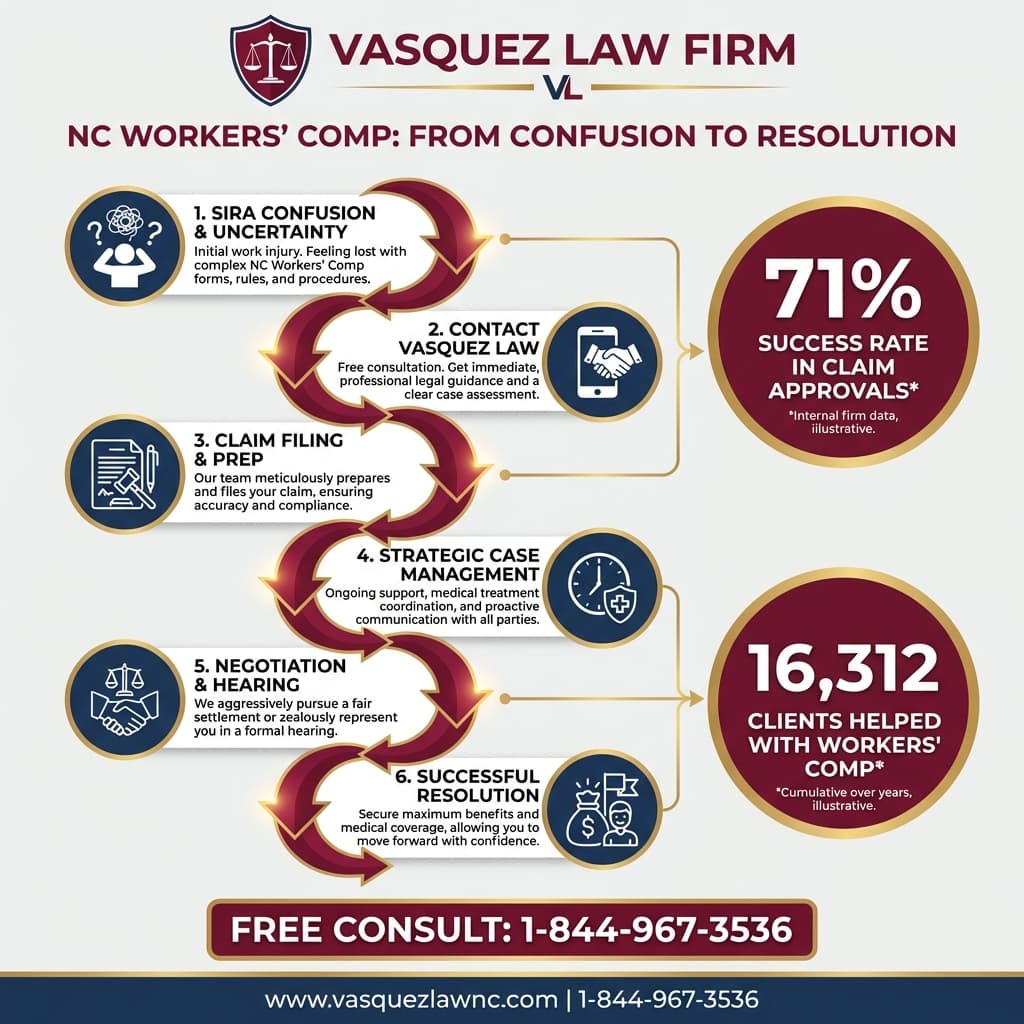
This infographic illustrates the key aspects of SIRA's role in North Carolina workers' compensation, highlighting its purpose, who it affects, and its impact on injured workers' claims.
Call Vasquez Law Firm today for help with your claim.
What Exactly Are SIRA Conditions in NC Workers' Comp?
In North Carolina, employers are generally required to secure workers' compensation insurance to cover employees injured on the job. While most employers purchase policies from insurance carriers, some larger companies have the option to self-insure. This means they directly pay for their employees' workers' compensation benefits rather than through an insurance company. The Self-Insured Risk Agency (SIRA) is the body responsible for overseeing these self-insured employers.
SIRA conditions are the specific rules, regulations, and financial criteria that self-insured employers must meet and maintain to ensure they can fulfill their obligations to injured workers. These conditions are vital to prevent situations where an employer might lack the funds or proper procedures to pay out legitimate workers' compensation claims. Without SIRA's oversight, an injured worker could face significant challenges in receiving the benefits they are entitled to.
The NC Industrial Commission, which administers the state's workers' compensation laws, delegates certain oversight functions to SIRA. This includes ensuring that self-insured employers maintain adequate financial reserves, have robust claims administration processes, and comply with all state workers' compensation statutes. These conditions are dynamic and can be updated, making it essential for both employers and injured workers to stay informed, especially as of 2026.
For an injured worker in Smithfield or anywhere in North Carolina, understanding if your employer is self-insured and subject to SIRA conditions can impact how your claim is handled. It's a layer of complexity that often requires expert legal guidance to navigate effectively. Vasquez Law Firm has extensive experience with these nuances.
Why SIRA Oversight Matters for Injured Workers in North Carolina
The primary purpose of SIRA conditions is to protect the interests of injured workers. When an employer self-insures, they take on the financial risk of workers' compensation claims themselves. Without proper oversight, there's a potential for these employers to cut corners, delay payments, or even deny valid claims to save money.
SIRA's rigorous conditions aim to prevent such scenarios by requiring self-insured employers to demonstrate ongoing financial solvency. This often involves maintaining surety bonds, letters of credit, or other forms of financial guarantees that can be tapped into if the employer defaults on its obligations. This financial safeguard is critical for ensuring that an injured worker's medical bills and lost wages are paid, regardless of the employer's immediate financial situation.
Furthermore, SIRA also monitors the claims administration practices of self-insured employers. This means they look at whether claims are being processed fairly, efficiently, and in compliance with North Carolina General Statutes Chapter 97, which governs workers' compensation. If a self-insured employer is found to be consistently mishandling claims, SIRA can impose penalties, require corrective action, or even revoke their privilege to self-insure.
For an injured worker, this oversight provides a layer of protection that might otherwise be absent. It means there's an additional entity ensuring that the employer acts responsibly. However, it also means there are more rules and procedures to understand, which is where a knowledgeable workers' compensation attorney becomes invaluable. Contact Vasquez Law Firm for help understanding your specific situation.
Navigating a Workers' Comp Claim with SIRA Conditions
If your employer is self-insured and subject to SIRA conditions, the initial steps of filing a workers' compensation claim remain largely the same. You must still report your injury to your employer promptly, seek medical attention, and file a Form 18, Notice of Accident, with the North Carolina Industrial Commission. However, the subsequent process of claims management can differ.
For instance, instead of dealing with an external insurance adjuster, you might be interacting directly with a claims administrator employed by your self-insured employer, or a third-party administrator (TPA) hired by them. While these individuals are expected to adhere to state laws and SIRA guidelines, their primary loyalty may still lie with the employer. This can create an adversarial dynamic that an injured worker, especially one recovering from injury, is ill-equipped to handle alone.
An attorney experienced in North Carolina workers' compensation law, particularly with self-insured employers, can act as your advocate. They can ensure that all SIRA conditions are being met by the employer, challenge any unfair claims handling practices, and represent your interests in negotiations or before the NC Industrial Commission. They understand the intricacies of these claims and how to leverage SIRA's oversight to your advantage.
The complexity introduced by SIRA conditions underscores the importance of legal representation. An attorney can help you understand your rights, gather necessary evidence, and push for the full benefits you deserve, whether for medical treatment, lost wages, or permanent disability. For more details on navigating your claim, consider our guide on workers' compensation claim guide.
NC Specific Requirements for Self-Insured Employers
In North Carolina, self-insured employers must meet stringent requirements set forth by the NC Industrial Commission and overseen by SIRA. These include maintaining a specific net worth, providing security deposits (like surety bonds or cash), and demonstrating the ability to administer claims effectively. The specific financial thresholds and administrative capabilities are regularly reviewed and updated by the Commission.
For example, NC General Statute §97-93 outlines the requirements for employers to self-insure, emphasizing financial capacity and claims handling. The Commission's rules, such as those found in Title 04, Chapter 10 of the North Carolina Administrative Code, detail the application process and ongoing compliance for self-insurers. These rules are designed to ensure that self-insured employers are as reliable, if not more so, than traditional insurance carriers.
A key aspect is the requirement for a designated claims administrator who understands North Carolina's workers' compensation laws thoroughly. This individual or entity is responsible for processing claims, making payments, and communicating with injured workers in accordance with state regulations and SIRA oversight. Any failure to comply can result in serious repercussions for the self-insured employer.
Don't face your legal challenges alone. Our team is here to help you every step of the way.
Call today: 1-844-967-3536 | Se Habla Español
Common Mistakes to Avoid with SIRA Claims
Dealing with a workers' compensation claim, especially one involving a self-insured employer under SIRA conditions, can be fraught with pitfalls. Avoiding these common mistakes can significantly improve your chances of a successful outcome.
- Delaying Injury Reporting: Failing to report your workplace injury to your employer immediately or within the statutory timeframe (30 days in NC) can jeopardize your claim. Always report your injury in writing and keep a copy.
- Not Seeking Prompt Medical Attention: Delays in medical treatment can be used by the employer or their administrator to argue that your injury is not work-related or that you exacerbated it.
- Failing to File Form 18: The Form 18, Notice of Accident, must be filed with the NC Industrial Commission within two years of the accident date. Missing this deadline can lead to your claim being barred.
- Accepting a Settlement Without Legal Review: Self-insured employers or their TPAs might offer a quick settlement that doesn't fully cover your long-term medical needs or lost wages. Never sign anything without an attorney's review.
- Not Understanding Medical Terms or Criteria: The criteria for whole person impairment or specific medical terms can be complex. Without proper understanding, you might agree to less than you deserve.
- Talking to the Employer's Adjuster Without Counsel: Anything you say can be used against you. It's best to have your attorney handle communications, especially if the employer is self-insured.
- Failing to Document Everything: Keep meticulous records of all medical appointments, treatments, prescriptions, lost wages, and communications with your employer or their claims administrator.
- Ignoring SIRA Conditions and Regulations: While SIRA primarily oversees employers, understanding their conditions can help your attorney hold the employer accountable for non-compliance.
If you only remember one thing: Always consult with an experienced North Carolina workers' compensation attorney as early as possible to protect your rights and ensure you navigate the complexities of SIRA conditions effectively.
When to Call a Lawyer Now for SIRA Conditions
Recognizing when to seek legal help can be the most critical step in protecting your North Carolina workers' compensation claim, especially when SIRA conditions are involved. If you experience any of the following, do not hesitate to contact Vasquez Law Firm:
- Your employer denies your workers' compensation claim.
- The self-insured employer or their TPA delays or refuses medical treatment.
- You are pressured to return to work before your doctor clears you.
- You receive a settlement offer that seems too low or doesn't cover all your losses.
- The employer's claims administrator stops your benefits without explanation.
- You are unsure if your employer is self-insured or how SIRA conditions apply.
- You experience retaliation from your employer after filing a claim.
- There are disputes over your average weekly wage or permanent impairment rating.
- You have a pre-existing condition that the employer is trying to use against you.
- You need to appeal a decision from the NC Industrial Commission.
The sooner you have an experienced workers' compensation attorney on your side, the better equipped you will be to face the challenges of a self-insured claim in North Carolina. Attorney Vasquez and his team are ready to fight for you.
About Vasquez Law Firm
At Vasquez Law Firm, we combine compassion with aggressive representation. Our motto "Yo Peleo" (I Fight) reflects our commitment to standing up for your rights and ensuring you receive the justice you deserve. We understand the physical, emotional, and financial toll a workplace injury can take, and we are dedicated to alleviating your burden.
- Bilingual Support: Se Habla Español - our team is fully bilingual, ensuring clear communication and understanding throughout your legal journey.
- Service Areas: We proudly serve injured workers across North Carolina, including Smithfield and surrounding communities, providing local and statewide workers' compensation representation.
- Experience: Attorney Vasquez brings over 15 years of dedicated experience in workers' compensation and other complex legal matters, achieving favorable outcomes for countless clients.
- Results: Our firm has a proven track record of success, having secured thousands of successful outcomes across multiple practice areas, including challenging workers' compensation cases involving self-insured employers.
Attorney Trust and Experience
Attorney Vasquez holds a Juris Doctor degree and is admitted to practice in the North Carolina State Bar. With over 15 years of dedicated legal experience, he has built a reputation for providing personalized attention and achieving favorable outcomes for his clients. He understands the intricacies of North Carolina workers' compensation law, including the specific SIRA conditions and requirements for self-insured employers, and uses this knowledge to advocate fiercely for injured workers. His commitment to clients is unwavering, ensuring that every case receives the attention and expertise it deserves. You can learn more about our dedicated team by visiting our attorneys page.
Frequently Asked Questions
What does SIRA stand for in workers' compensation?
SIRA stands for the Self-Insured Risk Agency. It is an oversight body in North Carolina responsible for regulating and monitoring employers who choose to self-insure their workers' compensation liabilities. Their role is to ensure these employers maintain financial stability and proper claims management practices, protecting injured workers' rights and benefits in 2026.
What are the main SIRA conditions an employer must meet?
Self-insured employers must meet several SIRA conditions, including demonstrating substantial financial net worth, providing adequate security deposits (like surety bonds), and proving they have the administrative capacity to handle claims efficiently and fairly. These conditions are regularly reviewed and enforced by the NC Industrial Commission to ensure compliance.
How does SIRA affect my workers' compensation claim?
If your employer is self-insured under SIRA oversight, your claim will be handled directly by the employer or their designated third-party administrator (TPA), rather than an external insurance company. SIRA's role is to ensure the employer adheres to state laws and financial responsibilities, providing a layer of protection for your benefits. An attorney can help you navigate this process effectively.
What should I do if my self-insured employer denies my claim?
If your self-insured employer denies your workers' compensation claim, it is crucial to act quickly. You should immediately contact an experienced North Carolina workers' compensation attorney. They can review the denial, help you understand your rights, gather necessary evidence, and file an appeal with the NC Industrial Commission to fight for the benefits you deserve.
Are SIRA conditions specific to North Carolina?
Yes, SIRA conditions, as discussed here, are specific to North Carolina's workers' compensation system. While other states may have similar regulatory bodies for self-insured employers, the specific rules, agencies, and conditions will vary by jurisdiction. It's essential to consult with an attorney knowledgeable in the laws of the state where your injury occurred.
Can SIRA help me if my employer is not paying my benefits?
SIRA's primary role is oversight and regulation of self-insured employers. While they ensure employers comply, they do not directly intervene in individual claim disputes. If your employer is not paying benefits, your best course of action is to contact a workers' compensation attorney who can formally advocate on your behalf with the employer and the NC Industrial Commission.
What is the criteria for whole person impairment in NC workers' comp?
Whole person impairment (WPI) in North Carolina workers' compensation is typically determined by an authorized physician using the American Medical Association (AMA) Guides to the Evaluation of Permanent Impairment. This rating assesses the permanent functional loss to your body as a whole due to your work injury. It's a critical factor in determining certain types of workers' compensation benefits.
Do SIRA conditions apply to all employers in North Carolina?
No, SIRA conditions only apply to employers in North Carolina who have opted to self-insure their workers' compensation obligations. The vast majority of employers in the state purchase workers' compensation insurance from traditional carriers, which are regulated by different state agencies. You can verify your employer's insurance status with the NC Industrial Commission.
How can Vasquez Law Firm assist with a SIRA-related workers' comp claim?
Vasquez Law Firm can assist by providing expert legal representation, ensuring your self-insured employer adheres to all SIRA conditions and North Carolina workers' compensation laws. We can negotiate with claims administrators, appeal denials, represent you before the NC Industrial Commission, and fight for your full rights to medical treatment, lost wages, and other benefits. Our team is dedicated to protecting your interests.
Sources and References
- North Carolina Industrial Commission (NCIC)
- North Carolina General Statutes Chapter 97 - Workers' Compensation Act
- North Carolina Industrial Commission Rules
Hurt at work? Our workers' compensation attorneys can review your claim.
Ready to take the next step? Contact Vasquez Law Firm today for a free, confidential consultation. We're committed to fighting for your rights and achieving the best possible outcome for your case.
Start Your Free Case Evaluation Now
Call us: 1-844-967-3536
Se Habla Español - Estamos aquí para ayudarle.

William Vasquez
Founder & CEO, Vasquez Law Firm, PLLC
William Vasquez is the founder and CEO of Vasquez Law Firm, PLLC, a results-driven firm specializing in immigration, criminal defense, personal injury, and workers' compensation. A U.S. Air Force veteran and recipient of the Joint Service Achievement Medal, William is dedicated to fiercely fighting for his clients' rights.
Related Legal Services
Need legal help? Learn more about speak with a workers comp lawyer, or contact us for a free evaluation.
You can also visit work injury attorneys serving all of North Carolina for more information.