How USCIS Rescinded the 2022 Public Charge Rule in 2026
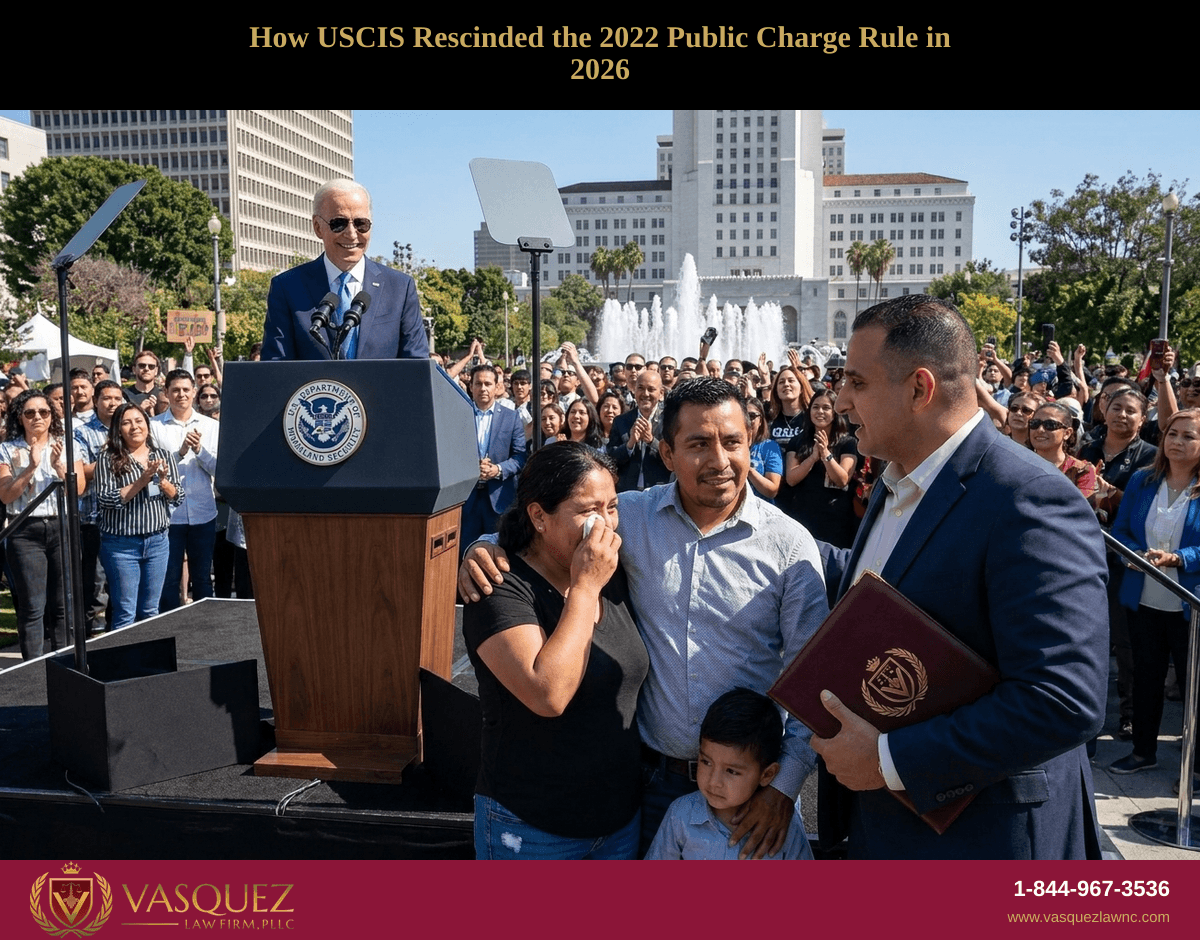
The USCIS rescinded the 2022 public charge regulation on July 16, 2026, effective September 18, 2026. This change restores immigration officers' ability to consider all relevant public benefits when deciding visa and green card applications. Applicants in Raleigh, NC and Orlando, FL should prepare for a broader review of their financial status and public benefit use under the new rule. The revised Form I-485 will be mandatory for adjustment of status filings after September 18, 2026.
Published on July 16, 2026
Talk to an immigration attorney
Free call. A clear plan for your case.
Free & confidential · Se habla espanol · 24/7
Have questions? Talk to an attorney - free evaluation.
Call 1-844-967-3536Free Tool
Check Your USCIS Case Status Now
Enter your receipt number - get the official USCIS status in English or Spanish. No registration.
This article provides general legal information, not individualized legal advice. Reading does not create an attorney-client relationship. For advice specific to your situation, contact Vasquez Law Firm.
What did USCIS change about the public charge rule in July 2026?
Ready to Apply for a Green Card?
Family-based, employment-based, or other paths — we guide you through every step.
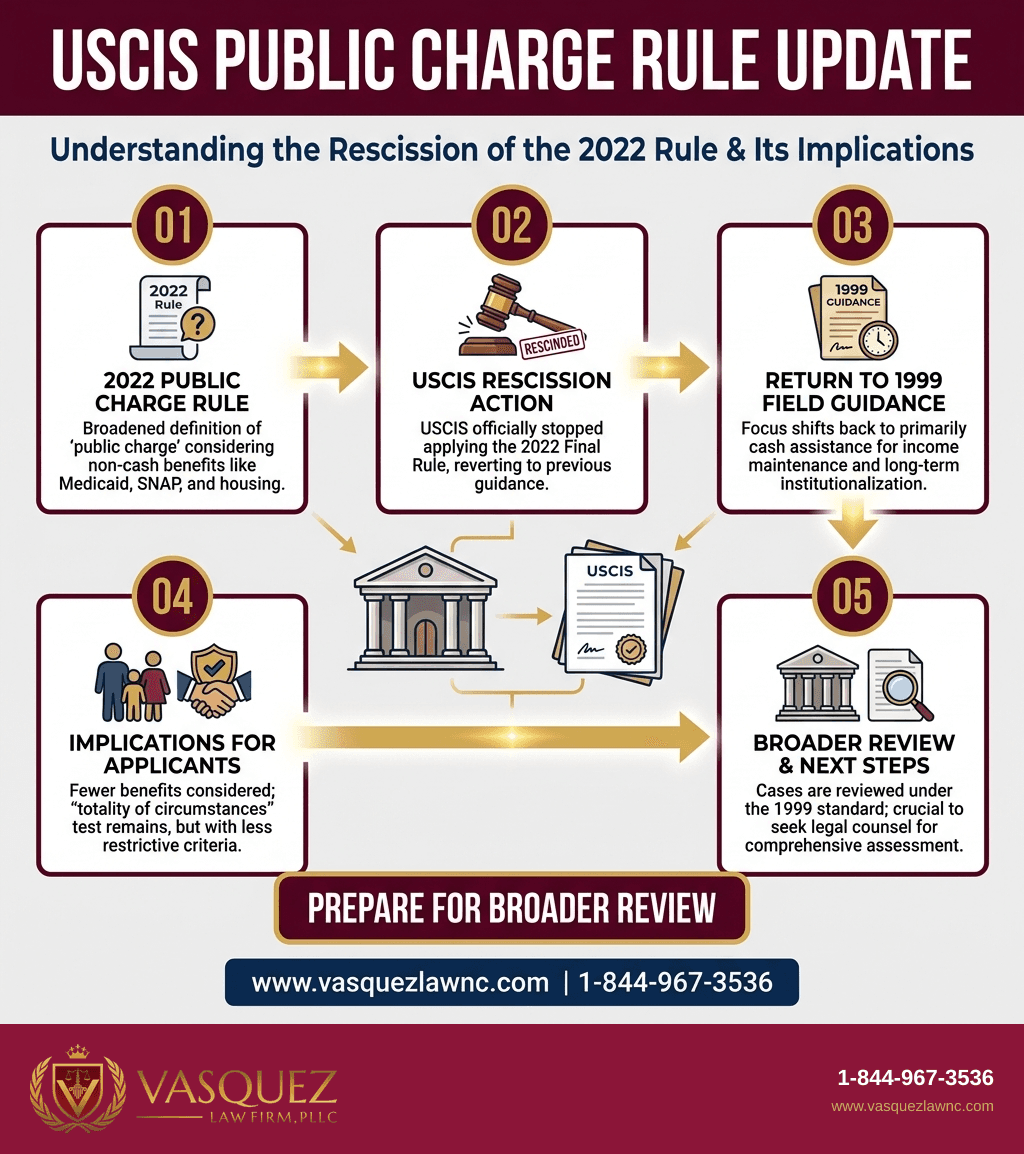
USCIS rescinded the 2022 Biden-era public charge regulation on July 16, 2026, effective September 18, 2026. The new final rule restores the ability of immigration officers to consider all relevant factors, including a broad range of public benefits, when determining if an applicant is likely to become a public charge. This reverses the 2022 rule’s narrower approach that limited which benefits could be considered.
The Department of Homeland Security (DHS) announced this change to align immigration policy with Congressional intent that aliens be self-reliant and not dependent on taxpayer-funded benefits. The 2022 regulation had restricted officers’ discretion by excluding many public benefits from consideration. Now, USCIS officers will assess each applicant’s circumstances on a case-by-case basis, reviewing all pertinent facts.
This change affects visa applicants, those seeking admission to the United States, and individuals applying for adjustment of status (green cards). USCIS will issue a revised Form I-485, Application to Register Permanent Residence or Adjust Status, which applicants must use starting September 18, 2026. Forms postmarked or submitted electronically on or after that date using the old version will be rejected.
USCIS spokesperson Zach Kahler emphasized the administration’s commitment to protecting American taxpayers by preventing subsidization of aliens likely to become public charges. This policy shift marks a return to a more expansive public charge assessment consistent with the Immigration and Nationality Act (INA).
Who is affected by the rescission of the 2022 public charge regulation?
The rescission affects all noncitizens applying for visas, admission, or adjustment of status in the United States, including many residents of Raleigh, NC and Orlando, FL. Applicants who previously benefited from the narrower 2022 rule’s limited scope of public benefits considered will now face a broader review of their public benefit use and financial status.
Specifically, immigrant visa applicants abroad and adjustment of status applicants within the U.S. will have their likelihood of becoming a public charge evaluated using all relevant factors. This includes consideration of public benefits such as Medicaid, Supplemental Nutrition Assistance Program (SNAP), housing assistance, and others that were restricted under the 2022 rule.
In North Carolina, which has a significant immigrant population, thousands of individuals applying for lawful permanent residence or visas may experience changes in how their applications are reviewed. Orlando, FL, where our Florida office is located, also has a large immigrant community that will be impacted by these changes.
The broader review may affect applicants’ eligibility and require more detailed documentation of financial stability and lack of dependency on public benefits. This could lead to increased denials or requests for additional evidence, especially for applicants with prior use of public benefits.
Applicants with pending cases should monitor USCIS announcements closely and consult immigration counsel to understand how the new rule applies to their situation. The revised Form I-485 will be mandatory for adjustment of status filings on or after September 18, 2026.
What does the Immigration and Nationality Act say about public charge?
The Immigration and Nationality Act (INA) prohibits admission or adjustment of status for any alien likely at any time to become a public charge. This means the government can deny visas or green cards to individuals who are expected to rely primarily on government assistance for subsistence.
The rescinded 2022 regulation had narrowed which public benefits immigration officers could consider, limiting their ability to evaluate all relevant factors Congress intended. The new rule restores the original statutory framework, allowing officers to review all pertinent facts on a case-by-case basis.
According to the USCIS announcement,
"Under the Immigration and Nationality Act (INA), an individual applying for a visa, admission, or adjustment of status is inadmissible to the United States if deemed likely at any time to become a public charge. The now-rescinded Biden-era regulation restricted which public benefits DHS could consider, limiting officers’ ability to review all relevant factors as intended by Congress." (Source: USCIS, https://www.uscis.gov/newsroom/news-releases/us-citizenship-and-immigration-services-rescinds-2022-public-charge-regulation)
This statutory basis is codified in 8 U.S.C. § 1182(a)(4), which defines inadmissibility on public charge grounds. The INA gives immigration officers discretion to consider the totality of circumstances, including age, health, family status, assets, resources, financial status, education, and skills.
The rescission aligns USCIS policy with this statutory intent, allowing a more comprehensive review of applicants’ likelihood of becoming dependent on government benefits.
What should applicants do in light of the USCIS public charge rule change?
Applicants for visas or adjustment of status should prepare for a broader and more detailed public charge review starting September 18, 2026. This means gathering comprehensive documentation about income, assets, health insurance, employment, and any public benefits used.
At our Raleigh, NC and Orlando, FL offices, we typically see applicants underestimate the importance of detailed financial evidence and explanations of public benefit use. Many do not realize that even past use of certain benefits can impact their application under the public charge analysis.
Here are key steps applicants should take:
- Review your public benefit history carefully and document all benefits received.
- Gather proof of stable income, savings, and assets to demonstrate self-reliance.
- Obtain health insurance coverage documentation, as lack of coverage can weigh against you.
- Consult with an experienced immigration attorney to assess your case and prepare evidence.
- Use the revised Form I-485 for adjustment of status applications filed on or after September 18, 2026.
Failure to provide sufficient evidence may result in Requests for Evidence (RFEs) or denials. Applicants should avoid submitting outdated forms or incomplete documentation.
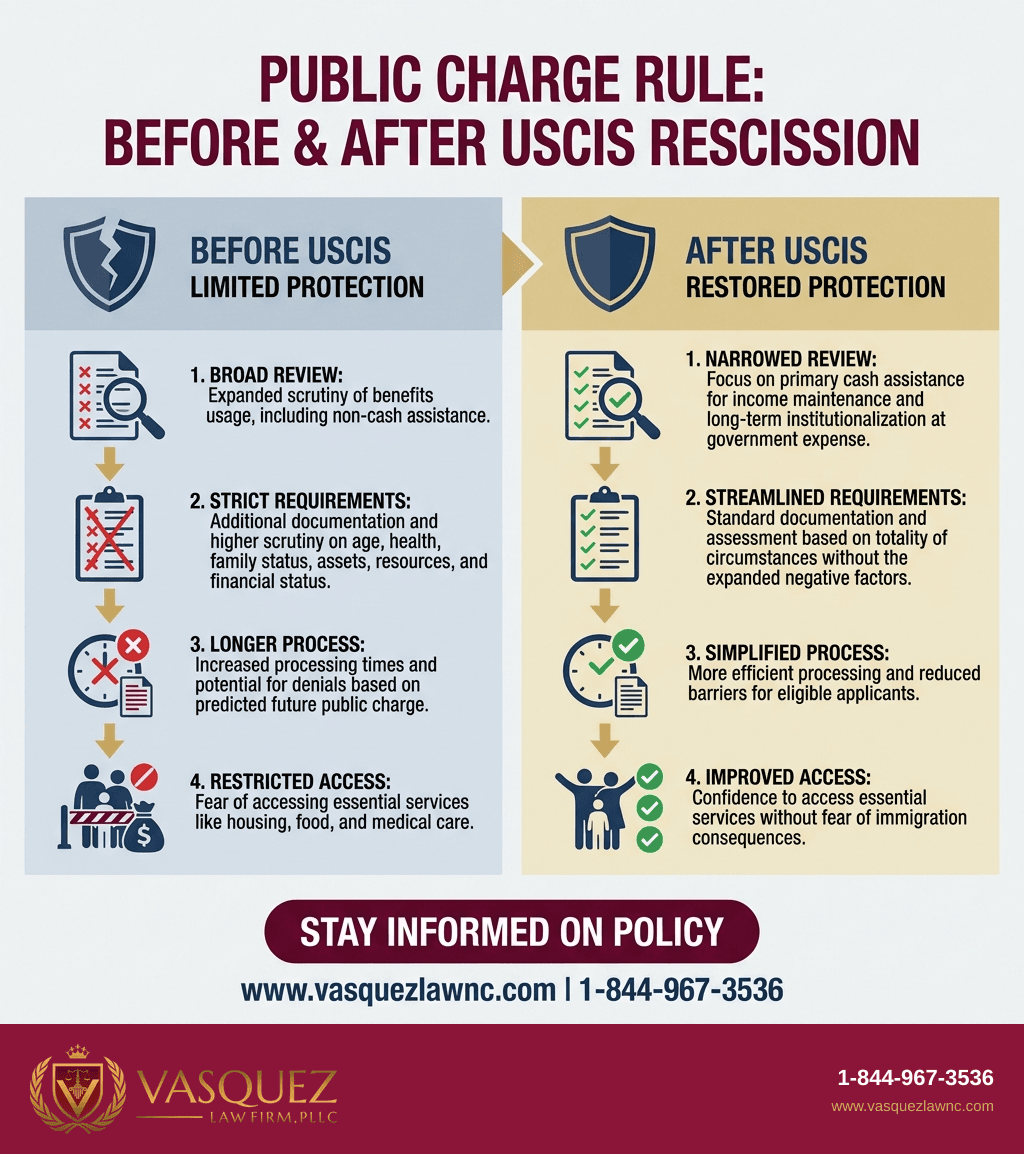
The table below summarizes key differences applicants should note before and after the rule change:
| Aspect | Before Sept. 18, 2026 (2022 Rule) | After Sept. 18, 2026 (Rescinded Rule) |
|---|---|---|
| Public Benefits Considered | Limited to certain benefits only | All relevant public benefits considered |
| Officer Discretion | Restricted discretion | Full discretion on case-by-case basis |
| Form I-485 | Older versions accepted | Only revised Form I-485 accepted |
| Impact on Applicants | Less scrutiny on public benefit use | More comprehensive review and documentation required |
Applicants in Raleigh, NC and Orlando, FL should act promptly to update their applications and consult legal counsel to avoid pitfalls.
For more information, visit our immigration practice area page or contact our offices directly.
What happens next with USCIS public charge policy after the rescission?
USCIS will implement the rescinded public charge rule starting September 18, 2026. This includes publishing a revised Form I-485 that applicants must use for adjustment of status filings on or after that date. Older versions will no longer be accepted.
The agency will train adjudicators to apply the broader public charge analysis consistent with Congressional intent. This means officers will consider all relevant facts and public benefits, restoring a more expansive assessment than under the 2022 rule.
USCIS stated,
What's Your Immigration Situation?
Answer 3 questions - we'll tell you your options
Question 1 / 3
What best describes your situation?
Keep Reading
"USCIS officers are empowered to assess all pertinent facts on a case-by-case basis for each applicant. ‘The Trump administration is upholding the rule of law and protecting American taxpayers from subsidizing aliens who may become dependent on public benefits. USCIS is committed to safeguarding the safety, security, and financial well-being of Americans,’ said U.S. Citizenship and Immigration Services spokesperson Zach Kahler." (Source: USCIS, https://www.uscis.gov/newsroom/news-releases/us-citizenship-and-immigration-services-rescinds-2022-public-charge-regulation)
Applicants should expect increased scrutiny and possibly longer processing times as USCIS adjusts to the new policy. Legal challenges or further regulatory changes could arise, but for now, the rescission stands as the controlling policy.
Staying informed through official USCIS channels and consulting immigration attorneys in Raleigh, NC and Orlando, FL remains critical for affected individuals.
Frequently Asked Questions about the USCIS Public Charge Rule Change
What is the public charge rule?
The public charge rule allows USCIS to deny visas or green cards to applicants likely to rely primarily on government benefits for subsistence. It aims to ensure immigrants are self-reliant and not a burden on taxpayers.
When does the rescinded public charge rule take effect?
The rescinded rule takes effect on September 18, 2026. After this date, USCIS will consider all relevant public benefits in public charge determinations.
How does this change affect adjustment of status applicants?
Applicants filing Form I-485 on or after September 18, 2026, must use the revised form and prepare for a broader public charge review, including documentation of public benefit use and financial status.
Can public benefits used before the rule change affect my application?
Yes. USCIS will consider all relevant facts, including past use of public benefits, when determining likelihood of becoming a public charge under the rescinded rule.
Where can I get help understanding the new public charge rule?
Consult experienced immigration attorneys, such as those at Vasquez Law Firm in Raleigh, NC and Orlando, FL. They can provide guidance tailored to your case and help prepare your application.
This article provides general legal information, not individualized legal advice. Reading does not create an attorney-client relationship. For advice specific to your situation, contact Vasquez Law Firm.
Reviewed by William Vasquez, Founder & CEO, Vasquez Law Firm, PLLC.
Related Topics

William Vasquez
Founder & CEO, Vasquez Law Firm, PLLC
William Vasquez is the founder and CEO of Vasquez Law Firm, PLLC, a results-driven firm specializing in immigration, criminal defense, personal injury, and workers' compensation. A U.S. Air Force veteran and recipient of the Joint Service Achievement Medal, William is dedicated to fiercely fighting for his clients' rights.
Related Legal Services
Need legal help? Learn more about our immigration legal services, or contact us for a free evaluation.
You can also visit our North Carolina immigration practice for more information.