What the Eleventh Circuit 220A Detention Dispute Means for Immigrants in 2026
Understand the Eleventh Circuit's decision to remand the 220A detention statute dispute in 2026. Get critical insights for your immigration case. Contact Vasquez Law for a free consultation today.
Published on February 24, 2026
Talk to an immigration attorney
Free call. A clear plan for your case.
Free & confidential · Se habla espanol · 24/7
Have questions? Talk to an attorney - free evaluation.
Call 1-844-967-3536Worried how the latest immigration news affects you?
Schedule a confidential case review with an immigration attorney - know exactly where you stand.
What the Eleventh Circuit 220A Detention Dispute Means for Immigrants in 2026
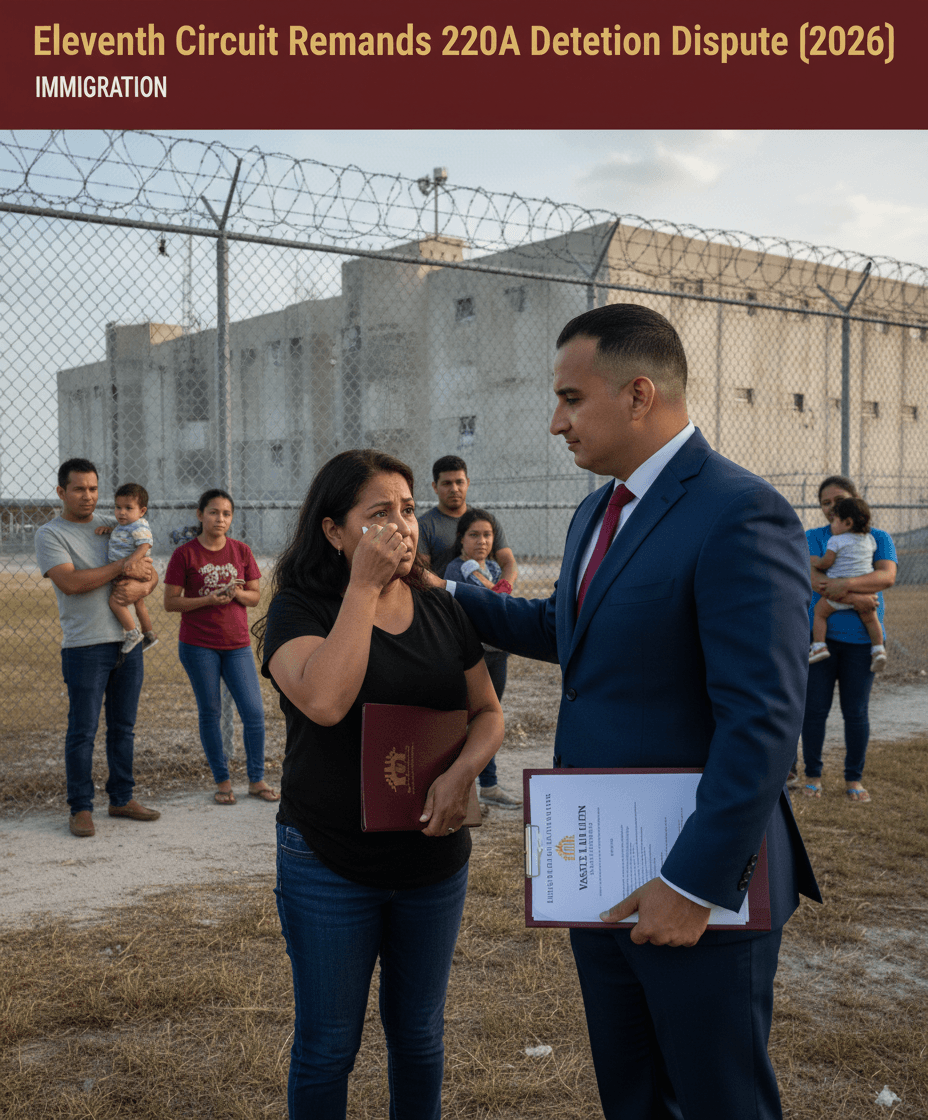
The Eleventh Circuit's decision to remand the 220A detention statute dispute to the Board of Immigration Appeals (BIA) marks a significant development in immigration law as of 2026. This ruling directly impacts individuals who have been detained under an I-220A, often referred to as an Order of Release on Recognizance, or those facing similar immigration detention challenges. Understanding the implications of this remand is crucial for immigrants and their families, particularly in North Carolina and Florida, where many such cases originate. The Vasquez Law Firm is closely monitoring these developments to provide the most current and effective legal strategies for our clients.
Need help with your immigration case, especially concerning I-220A issues or detention? Our experienced attorneys are ready to fight for you. Se Habla Español.
Schedule Your Free Case Evaluation
Or call us now: 1-844-967-3536
Quick Answer
The Eleventh Circuit recently remanded a key 220A detention statute dispute back to the BIA for further consideration. This decision highlights ongoing legal complexities regarding immigration detention, particularly for those released under an I-220A. It emphasizes the need for careful legal analysis of individual circumstances and the potential for a new wave of legal interpretations regarding release and detention.
- The ruling impacts immigrants detained under 8 U.S.C. § 1226.
- It underscores the evolving legal landscape for I-220A holders.
- Future BIA decisions will clarify the scope of this remand.
- Legal counsel is vital for navigating these complex issues in 2026.
Understanding the Eleventh Circuit Remand of the 220A Detention Statute Dispute
The Eleventh Circuit's decision to remand the 220A detention statute dispute is a pivotal moment for immigration law in 2026. This action means that a higher court has sent a case back to a lower body, in this instance, the Board of Immigration Appeals (BIA), for further review and decision. The core of this dispute revolves around the interpretation and application of detention statutes, specifically for individuals who have received an I-220A, or Order of Release on Recognizance.
An I-220A is typically issued to non-citizens released from U.S. Customs and Border Protection (CBP) custody without formal admission or parole. The legal status of these individuals, particularly concerning their eligibility for certain immigration benefits and their vulnerability to prolonged detention, has been a subject of extensive legal debate. The Eleventh Circuit's remand indicates that the appellate court found issues with how the BIA previously handled aspects of this detention dispute, requiring a re-evaluation based on specific legal principles or evidentiary standards.
For those residing in states like Florida, which falls under the Eleventh Circuit's jurisdiction, this ruling has immediate and significant implications. It introduces uncertainty but also potential opportunities for individuals whose cases might be affected by a new interpretation of the 220A detention statute. Legal professionals, including those at Vasquez Law Firm, are closely analyzing the nuances of this remand to prepare for the BIA's forthcoming decisions and their impact on clients' cases.
Who is Affected by the 220A Detention Decision?
The Eleventh Circuit's decision primarily affects non-citizens who have been released from immigration custody with an I-220A, Order of Release on Recognizance. These individuals often find themselves in a unique legal limbo, as their release does not grant them a formal immigration status like parole, which can impact their eligibility for work authorization, adjustment of status, or other relief from removal. The remand of this 220A detention statute dispute means that the legal framework governing their detention and eligibility for release is under renewed scrutiny.
Specifically, this ruling is relevant to individuals who may be subject to mandatory detention under provisions like 8 U.S.C. § 1226, even after being issued an I-220A. The dispute often centers on whether an I-220A constitutes a form of "parole" or "admission" that could exempt an individual from certain detention requirements or make them eligible for bond hearings. The Eleventh Circuit's call for further review by the BIA suggests that the existing interpretations may not fully address the complexities of these cases.
Immigrants in North Carolina and Florida, particularly those who entered the U.S. and received an I-220A, should pay close attention to the developments stemming from this remand. Their ability to challenge prolonged detention, seek release from immigration detention, or pursue other immigration remedies could be directly influenced by the BIA's revised guidance. Consulting with an immigration attorney is critical to understand how these changes might specifically apply to your situation.
Don't face your legal challenges alone. Our team is here to help you every step of the way, especially with complex immigration detention issues and the Eleventh Circuit's remand.
Call today: 1-844-967-3536 | Se Habla Español
Legal Implications and Future Outlook for 220A Cases
The Eleventh Circuit's remand of the 220A detention statute dispute carries significant legal implications for future immigration cases. One primary impact will be the BIA's re-evaluation of its precedent decisions concerning the legal status of individuals released on an I-220A. This could lead to new interpretations that define more clearly whether an I-220A is equivalent to parole for certain purposes, such as eligibility for adjustment of status under 8 U.S.C. § 1255.
For individuals currently in prolonged detention habeas proceedings under 28 U.S.C. § 2241, this remand could introduce new arguments for release or challenges to their detention. The BIA's updated guidance may provide clearer pathways for these individuals to seek bond hearings or motions to ameliorate conditions of release, which were previously denied based on a narrow interpretation of their release documentation. The goal is to ensure due process and fair treatment.
The ultimate outcome of this remand will likely shape how immigration detention and removal proceedings are conducted for thousands of non-citizens across the country, especially within the Eleventh Circuit's jurisdiction, which includes Florida. Attorneys at Vasquez Law Firm are closely monitoring the Executive Office for Immigration Review (EOIR) and BIA decisions to ensure our strategies remain aligned with the most current legal interpretations. We are committed to helping Dreamers and other affected individuals navigate this shifting landscape in 2026.
Strategic Steps for Immigrants with I-220A Status
If you are an immigrant holding an I-220A, or Order of Release on Recognizance, the Eleventh Circuit's decision to remand the 220A detention statute dispute makes it more critical than ever to take proactive legal steps. First, it is essential to understand the specifics of your I-220A document and how it was issued. This includes knowing the date of issuance, the issuing authority (CBP or ICE), and any conditions of your release. These details can significantly impact your legal options.
Next, you should immediately seek a comprehensive legal consultation with an experienced immigration attorney. An attorney can review your case, explain how the Eleventh Circuit's remand might affect you, and advise on potential strategies. This could involve filing a motion to ameliorate conditions of release, seeking a bond hearing if you are currently detained, or exploring eligibility for adjustment of status or other forms of relief based on evolving interpretations of the 220A.
Finally, stay informed about the ongoing developments from the BIA following this remand. The legal landscape is fluid, and new guidance or precedent decisions could emerge that directly impact your case. Vasquez Law Firm is dedicated to keeping our clients updated and adapting legal strategies to these changes, ensuring that you have the best possible representation in North Carolina, Florida, or anywhere nationwide.
What to Expect from the BIA
Following the Eleventh Circuit's remand, the Board of Immigration Appeals (BIA) will re-examine the legal questions surrounding the I-220A detention statute dispute. This process typically involves reviewing the arguments presented by both parties, considering any new evidence or legal precedents, and issuing a new decision. The BIA's decision will be crucial as it will provide a clearer interpretation of how an I-220A affects an individual's status regarding detention and eligibility for relief. This could lead to a more consistent application of the law across immigration courts, particularly concerning mandatory detention under INA 235 (8 U.S.C. § 1225).
NC, FL, and Nationwide Notes on I-220A and Detention
Florida Notes
As a state within the Eleventh Circuit's jurisdiction, Florida is directly impacted by this remand. Many immigration cases in Florida, particularly those involving individuals released with an I-220A, will be subject to the BIA's forthcoming interpretations. The Orlando area, for example, has a significant immigrant population, and local immigration courts and detention centers will need to adapt to any new guidance. Our firm serves clients across Florida, including Orlando, providing expert legal counsel on these evolving issues.
North Carolina Notes
While North Carolina falls under the Fourth Circuit, the Eleventh Circuit's decision can still influence legal arguments and strategies nationwide. Immigration law is predominantly federal, and interpretations by one circuit court of appeals can be cited as persuasive authority in others. Immigrants in North Carolina with I-220A documents should still seek legal advice to understand potential impacts and how this remand might shape future federal immigration policies or court decisions relevant to their cases.
Nationwide Concepts (General only, rules vary)
The legal debate surrounding the I-220A and detention statutes is a national issue. While the Eleventh Circuit's ruling is specific to its jurisdiction, the fundamental questions it raises about the nature of release on recognizance and its implications for detention and eligibility for immigration benefits resonate across the country. The BIA's eventual decision will likely be a significant development for immigration attorneys and non-citizens nationwide, potentially influencing future legislation or judicial review in other circuits. The Vasquez Law Firm represents clients across the nation in immigration matters, staying abreast of all federal developments.
When to Call an Immigration Lawyer Now
The complexities surrounding the Eleventh Circuit's remand of the 220A detention statute dispute make it crucial to seek immediate legal counsel if you fall into any of the following categories:
- You were released with an I-220A and are unsure of your current immigration status or eligibility for benefits.
- You are currently in immigration detention and were previously released on an I-220A.
- You have an upcoming immigration court hearing or a pending application for adjustment of status.
- You are facing removal proceedings and have an I-220A in your immigration history.
- You believe you are eligible for release from immigration detention but have been denied.
- You are a family member of someone in detention with an I-220A and need guidance.
- You received a motion to ameliorate conditions of release and need assistance.
- You are confused about the implications of the Eleventh Circuit's remand for your specific case.
About Vasquez Law Firm
At Vasquez Law Firm, we combine compassion with aggressive representation. Our motto "Yo Peleo" (I Fight) reflects our commitment to standing up for your rights, especially in complex immigration matters like the Eleventh Circuit's remand of the 220A detention statute dispute. We understand the unique challenges faced by immigrants and their families, and we are dedicated to providing personalized and effective legal solutions.
- Bilingual Support: Se Habla Español - our team is fully bilingual and ready to assist you in your preferred language.
- Service Areas: We proudly serve clients in North Carolina, Florida, and provide nationwide immigration services.
- Experience: With over 15 years of dedicated legal experience, we have a proven track record of helping clients navigate complex legal matters.
- Results: Attorney Vasquez has successfully handled thousands of cases across multiple practice areas, always striving for the best possible outcome.
Attorney Trust and Experience
Attorney Vasquez, JD, is admitted to practice in both the North Carolina State Bar and Florida Bar. His extensive experience, spanning over 15 years, is marked by a deep understanding of immigration law and a commitment to his clients. He has built a reputation for providing personalized attention, strategic advocacy, and achieving favorable outcomes, making him a trusted advocate for Dreamers and all immigrants facing legal challenges in 2026.
Frequently Asked Questions
What does it mean for the Eleventh Circuit to remand a case?
When the Eleventh Circuit remands a case, it sends it back to a lower court or administrative body, like the Board of Immigration Appeals (BIA), for further action. This typically occurs when the appellate court finds an error in the lower body's decision or requires additional fact-finding or legal analysis. For the 220A detention dispute, it means the BIA must re-evaluate aspects of the case based on the Circuit Court's guidance, potentially leading to a new ruling that clarifies detention policies.
What is an I-220A, Order of Release on Recognizance?
An I-220A, or Order of Release on Recognizance, is a document issued by U.S. Customs and Border Protection (CBP) to non-citizens who are released from custody without being formally admitted or paroled into the U.S. This document signifies release on one's own recognizance, often with conditions, but it does not grant a formal immigration status. The legal implications of holding an I-220A, particularly concerning eligibility for benefits and vulnerability to detention, are at the heart of the current legal dispute.
How does this remand affect individuals in Florida?
As Florida falls within the Eleventh Circuit's jurisdiction, individuals in Florida who hold an I-220A are directly affected by this remand. The BIA's subsequent decision will set precedent for how immigration courts in Florida interpret and apply detention statutes related to I-220A holders. This could impact eligibility for bond, challenges to prolonged detention, and pathways to adjustment of status for many immigrants across the state, including those in Orlando.
Can an I-220A impact eligibility for a Green Card?
The impact of an I-220A on Green Card eligibility is a central point of the ongoing legal dispute. Historically, an I-220A has not been uniformly recognized as an "admission" or "parole," which are often prerequisites for adjusting status to a lawful permanent resident (Green Card holder) under 8 U.S.C. § 1255. The Eleventh Circuit's remand seeks further clarification from the BIA, potentially opening new avenues or solidifying previous interpretations regarding I-220A holders' eligibility for such benefits.
What is prolonged detention habeas, and how does it relate?
Prolonged detention habeas refers to a legal challenge filed under 28 U.S.C. § 2241 by individuals who believe they are being unlawfully detained for an excessive period by immigration authorities. The Eleventh Circuit's remand of the 220A detention statute dispute is highly relevant because a clearer definition of an I-220A's legal status could strengthen arguments for release in habeas proceedings. It may provide a basis for arguing that certain individuals are not subject to mandatory detention or are entitled to a bond hearing.
What is the significance of 8 U.S.C. § 1226 in this dispute?
8 U.S.C. § 1226 outlines the authority for the arrest and detention of aliens, including provisions for mandatory detention in certain circumstances (INA 235). The dispute often centers on whether an I-220A exempts an individual from these mandatory detention provisions or provides a pathway to a bond hearing. The Eleventh Circuit's remand prompts the BIA to clarify how I-220A holders fit within the framework of 8 U.S.C. § 1226, influencing decisions on release and detention eligibility.
Should I consult an attorney if I have an I-220A?
Yes, absolutely. Given the evolving legal landscape surrounding the Eleventh Circuit's remand of the 220A detention statute dispute, consulting an experienced immigration attorney is crucial. An attorney can assess your specific situation, explain the potential impacts of this ruling on your case, and help you navigate complex immigration laws. They can advise on strategies for challenging detention, pursuing relief, or clarifying your immigration status, especially as new BIA guidance emerges in 2026.
What is a motion to ameliorate conditions of release?
A motion to ameliorate conditions of release is a legal request filed with an immigration court or the BIA to modify or lessen the restrictions placed on an individual who has been released from detention. In the context of the 220A detention dispute, if the BIA's new guidance offers more favorable interpretations of an I-220A holder's status, it could provide stronger grounds for individuals to successfully file such motions, seeking less restrictive conditions or challenging the legality of their current release terms.
Sources and References
- U.S. Citizenship and Immigration Services (USCIS)
- Executive Office for Immigration Review (EOIR)
- 8 U.S. Code § 1226 - Arrest and detention of aliens
- 28 U.S. Code § 2241 - Power to grant writ
Need immigration help? Our immigration attorneys can review your case.
Ready to take the next step? Contact Vasquez Law Firm today for a free, confidential consultation. We're committed to fighting for your rights and achieving the best possible outcome for your case.
Start Your Free Case Evaluation Now
Call us: 1-844-967-3536
Se Habla Español - Estamos aquí para ayudarle.


William Vasquez
Founder & CEO, Vasquez Law Firm, PLLC
William Vasquez is the founder and CEO of Vasquez Law Firm, PLLC, a results-driven firm specializing in immigration, criminal defense, personal injury, and workers' compensation. A U.S. Air Force veteran and recipient of the Joint Service Achievement Medal, William is dedicated to fiercely fighting for his clients' rights.
Related Legal Services
Need legal help? Learn more about immigration lawyers in North Carolina, or contact us for a free evaluation.
You can also visit statewide immigration attorneys for more information.