How Trump Supreme Court Cases Affect Your Rights in 2026
Explore key Trump Supreme Court cases and their lasting impact on immigration and federal law as of 2026. Get expert legal help from Vasquez Law Firm. Contact us for a free consultation.
Published on February 22, 2026
Talk to an immigration attorney
Free call. A clear plan for your case.
Free & confidential · Se habla espanol · 24/7
Have questions? Talk to an attorney - free evaluation.
Call 1-844-967-3536Worried how the latest immigration news affects you?
Schedule a confidential case review with an immigration attorney - know exactly where you stand.
How Trump Supreme Court Cases Affect Your Rights in 2026
The landscape of American law, particularly immigration policy, has been significantly shaped by various Trump administration policies and the resulting Trump Supreme Court cases. As of 2026, understanding these landmark decisions is crucial for individuals navigating the complexities of federal law, especially those in North Carolina and Florida. Many of these cases addressed critical issues from executive power to immigration enforcement, leaving a profound legacy that continues to influence legal practices nationwide. This guide provides an in-depth look at these pivotal legal battles and their implications.
Need help understanding the impact of Trump Supreme Court cases on your immigration situation? Our experienced attorneys are ready to fight for you. Se Habla Español.
Schedule Your Free Case Evaluation
Or call us now: 1-844-967-3536
Quick Answer
Trump Supreme Court cases refer to the numerous legal challenges involving the Trump administration that reached the U.S. Supreme Court. These cases often centered on executive orders, regulatory changes, and constitutional questions, significantly impacting areas like immigration, administrative law, and presidential power. Their rulings continue to shape legal interpretation and policy across the nation in 2026.
- Key cases involved immigration policies, executive authority, and regulatory actions.
- Decisions have long-term implications for federal agencies and future administrations.
- The Supreme Court's composition changed significantly during his presidency.
- Many rulings clarified the separation of powers and administrative procedures.
- Impact felt nationwide, affecting individuals and businesses alike.
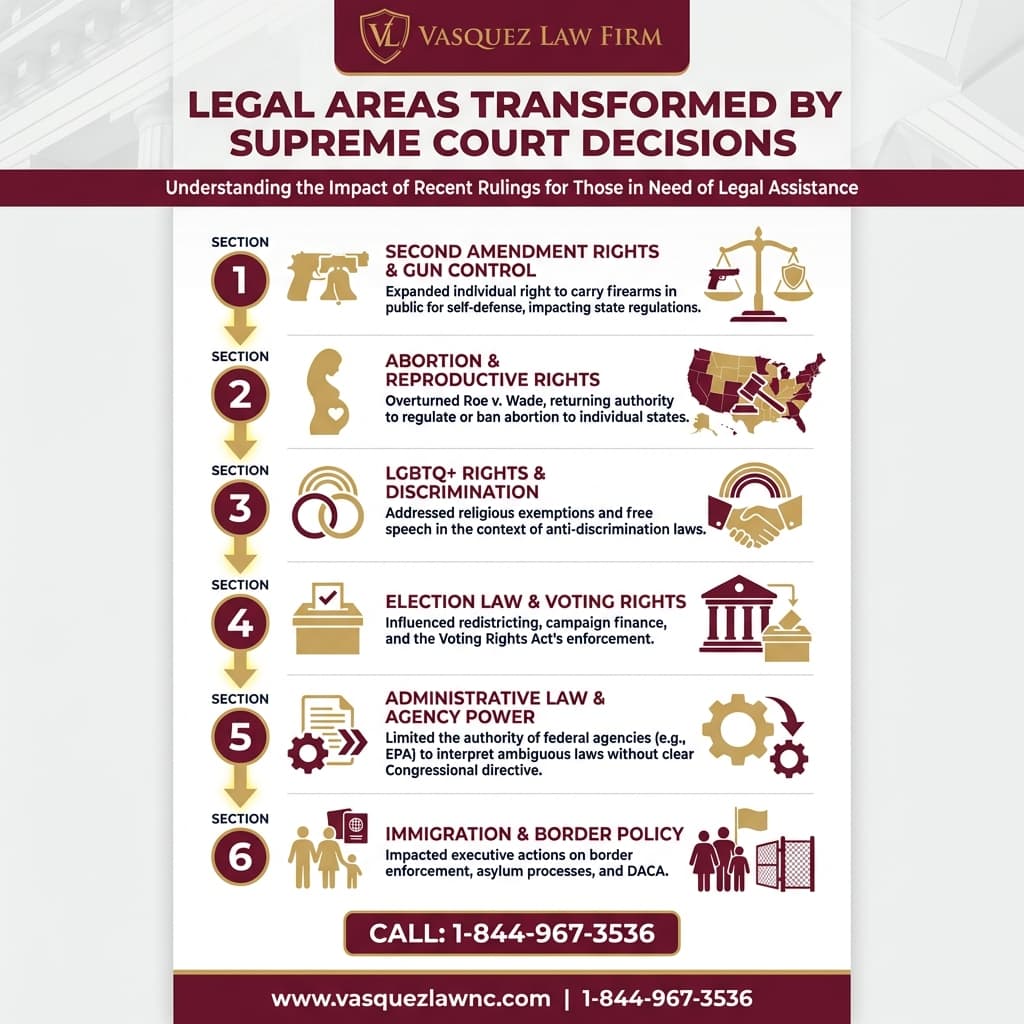
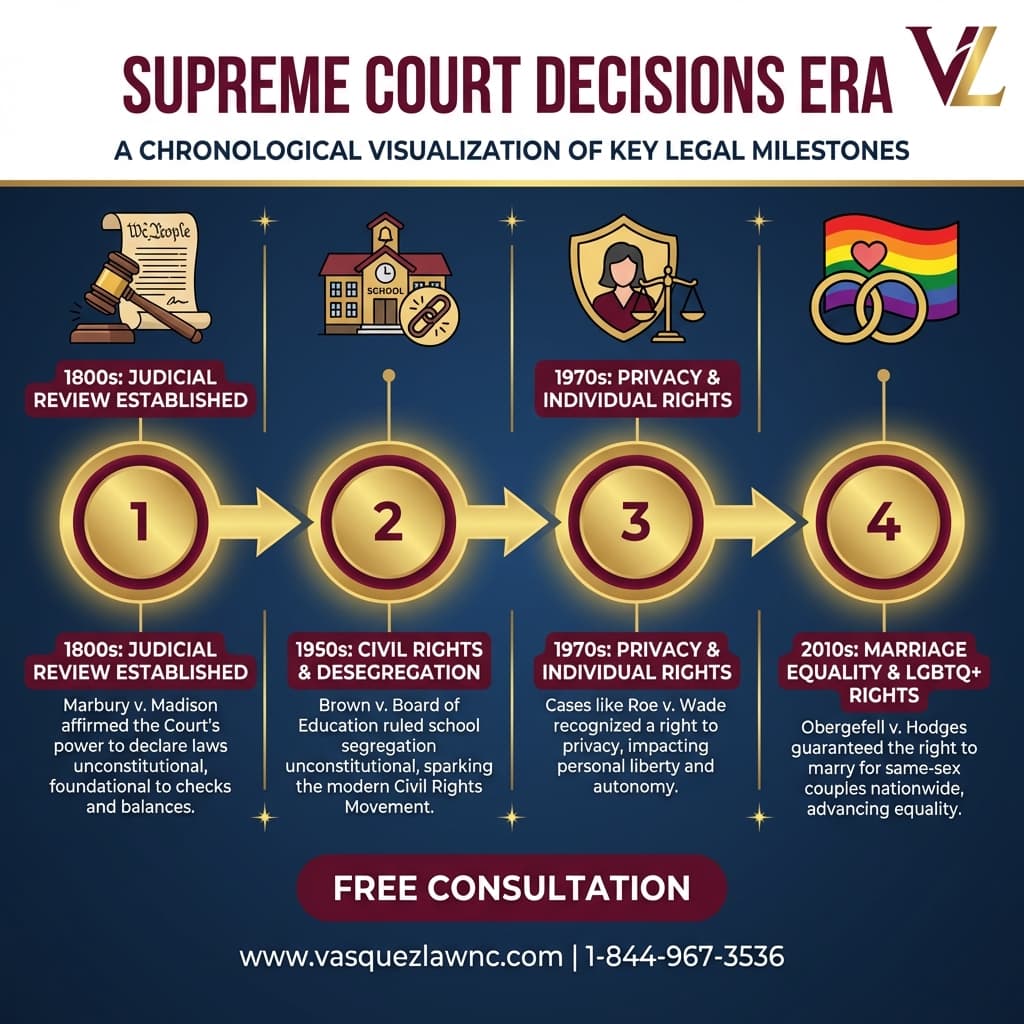
Infographic: Key Areas of Impact from Trump Supreme Court Cases
This infographic illustrates the primary legal domains significantly affected by the Trump Supreme Court cases, highlighting their lasting influence on federal law and policy across the United States.
Understanding the Legacy of Trump Supreme Court Cases
The presidency of Donald Trump brought an unprecedented number of legal challenges that eventually made their way to the U.S. Supreme Court. These Trump Supreme Court cases often tested the boundaries of executive authority, particularly concerning immigration and administrative law. For individuals and families in North Carolina and Florida, understanding these rulings is essential, as they continue to influence how federal agencies operate and how immigration laws are applied in 2026.
Many of these cases involved significant policy shifts, such as the travel ban, DACA (Deferred Action for Childhood Arrivals) program, and border wall funding. The Supreme Court's decisions in these matters have set important precedents, defining the scope of presidential power and the role of the judiciary in reviewing executive actions. These rulings are not merely historical footnotes; they actively shape current legal strategies and future policy debates, making it vital to stay informed.
The impact extends beyond the specific policies challenged. These cases have contributed to a broader legal discourse on the separation of powers, the role of federal agencies, and the rights of individuals under federal law. Vasquez Law Firm recognizes the ongoing relevance of these decisions for our clients, especially those dealing with immigration matters. We are committed to helping you navigate this complex legal landscape.
Key Areas Affected by Trump Supreme Court Rulings
The breadth of Trump Supreme Court cases touched upon various aspects of American life and law. Immigration was undoubtedly a central theme, with several high-profile challenges to executive orders and policy changes. These rulings determined the legality of certain deportation practices, the implementation of asylum restrictions, and the future of programs like DACA. For Dreamers and other immigrants, these decisions directly impacted their lives and legal standing.
Beyond immigration, the Supreme Court also heard cases related to environmental regulations, healthcare, and the powers of federal agencies. For instance, some cases examined the ability of agencies to implement significant policy changes without extensive public notice and comment, reinforcing principles of administrative law. These decisions have long-term implications for how future administrations can enact their agendas, providing a blueprint for legal challenges and governmental responses.
The Court's composition also played a significant role. With three new justices appointed during the Trump administration, the ideological balance of the Court shifted, influencing the outcomes of many of these cases. This shift continues to be a crucial factor in how the Supreme Court approaches contemporary legal issues in 2026, from voting rights to religious freedom. Understanding these dynamics is key to anticipating future legal trends.
Immigration Policy Challenges
Many of the most significant Trump Supreme Court cases directly addressed immigration policy. These included challenges to the travel ban, which restricted entry from several Muslim-majority countries. The Court ultimately upheld a revised version of the ban, affirming broad presidential authority over immigration matters. Another critical area involved the Deferred Action for Childhood Arrivals (DACA) program. While the Court did not rule on DACA's legality, it blocked the administration's attempt to terminate it without proper administrative procedures, providing a temporary reprieve for hundreds of thousands of Dreamers.
Additionally, cases related to border wall funding and asylum policies further highlighted the contentious nature of immigration law. These rulings often balanced executive power with congressional authority and constitutional due process. The decisions have had a profound and lasting impact on immigration enforcement, asylum seekers, and the rights of non-citizens across the United States, including in key states like North Carolina and Florida.
Executive Power and Separation of Powers
Several Trump Supreme Court cases explored the limits of executive power and the delicate balance of the separation of powers. Cases involving executive privilege, congressional subpoenas for presidential financial records, and the ability to fire agency heads tested constitutional boundaries. The Court often sought to clarify the checks and balances inherent in the U.S. system, ensuring that no single branch of government oversteps its authority. These rulings are vital for understanding the framework of American governance.
For example, in Trump v. Vance, the Supreme Court ruled that a sitting president is not absolutely immune from state criminal subpoenas, though it sent the case back to lower courts for further review. This decision underscored the principle that even the highest office is subject to the rule of law. Similarly, cases involving regulatory actions often scrutinized whether agencies adhered to proper administrative procedures, reinforcing the Administrative Procedure Act (APA) (5 U.S.C. § 551 et seq.).
Timeline: Major Trump Supreme Court Decisions
The period between 2017 and 2020 saw a flurry of significant Trump Supreme Court cases. Here's a brief timeline of some of the most impactful decisions:
- 2018: Trump v. Hawaii - The Supreme Court upheld the third version of the Trump administration's travel ban, which restricted entry for nationals from several countries, primarily citing national security concerns. This decision affirmed the President's broad authority under the Immigration and Nationality Act (INA) (8 U.S.C. § 1182(f)) to regulate the entry of non-citizens.
- 2019: Department of Commerce v. New York - The Court blocked the administration's attempt to add a citizenship question to the 2020 census, ruling that the rationale provided by the Commerce Department was pretextual. This case highlighted the importance of transparency and legitimate justification for administrative actions.
- 2020: Department of Homeland Security v. Regents of the University of California - The Supreme Court found that the Trump administration's attempt to end the DACA program was arbitrary and capricious under the Administrative Procedure Act, thus allowing the program to continue, at least temporarily. This was a major victory for Dreamers nationwide.
- 2020: Trump v. Vance - The Court held that a sitting president is not immune from state criminal subpoenas for personal financial records, though it required lower courts to consider presidential objections. This decision reinforced the principle that no one is above the law.
- 2020: Our Lady of Guadalupe School v. Morrissey-Berru - This ruling expanded the "ministerial exception" to anti-discrimination laws, allowing religious schools to choose their teachers based on religious criteria, impacting employment law.
These decisions represent just a fraction of the legal battles, but they illustrate the profound and varied impact of Trump Supreme Court cases on American jurisprudence. These rulings continue to be cited and debated in legal circles in 2026, influencing current legal strategies and shaping future policy debates.
Common Mistakes and How to Avoid Them in Immigration Cases
Navigating immigration law, especially with the shifting landscape influenced by Trump Supreme Court cases, can be fraught with peril. Many individuals make critical mistakes that can jeopardize their status or applications. Avoiding these pitfalls requires careful attention to detail and, often, professional legal guidance. Here are some common mistakes and how to prevent them:
- Ignoring Deadlines: Missing a filing deadline can result in denial or even deportation. Always keep track of all dates provided by USCIS or the Executive Office for Immigration Review (EOIR).
- Providing Incomplete or Inaccurate Information: Any discrepancies or omissions on forms can lead to delays, requests for evidence, or outright denials. Double-check all information and ensure it matches supporting documents.
- Failing to Disclose Criminal History: Even minor offenses can have major immigration consequences. Always be truthful about any criminal record, no matter how old or seemingly insignificant.
- Not Seeking Legal Advice: Many people try to handle complex immigration cases themselves, leading to errors. An experienced immigration attorney can help you understand the law and avoid mistakes.
- Assuming Old Laws Apply: Immigration law is constantly evolving, influenced by new legislation and court rulings, including those from Trump Supreme Court cases. Relying on outdated information is a common and dangerous mistake.
- Falling for Scams: Be wary of anyone offering "guaranteed" results or demanding large sums for simple forms. Always verify credentials. Immigration scams are rampant.
- Traveling Without Proper Authorization: Leaving the U.S. without an advance parole document or valid visa can lead to being denied re-entry, especially if you have a pending adjustment of status application.
- Failing to Understand Visa Categories: Applying for the wrong visa category can waste time and money. Ensure you meet the specific requirements for the visa you are seeking.
If you only remember one thing: Always seek professional legal counsel when dealing with immigration matters. The complexity of the law, especially after significant rulings like those in Trump Supreme Court cases, makes expert guidance invaluable.
Don't face your legal challenges alone. Our team is here to help you every step of the way, especially with the ongoing impact of Trump Supreme Court cases. Se Habla Español.
Call today: 1-844-967-3536 | Se Habla Español
Jurisdiction Notes: Immigration Across NC, FL, and Nationwide
Immigration law in the United States is primarily federal, meaning that the core statutes and regulations, as well as the impact of Trump Supreme Court cases, apply uniformly across all states, including North Carolina and Florida. However, the practical application and local enforcement can vary. Understanding these nuances is crucial for anyone navigating the U.S. immigration system in 2026.
Nationwide Federal Framework
The U.S. Citizenship and Immigration Services (USCIS) (www.uscis.gov) and the Executive Office for Immigration Review (EOIR) (www.justice.gov/eoir), which oversees immigration courts, operate under federal law. This means decisions from Trump Supreme Court cases, such as those impacting DACA or asylum processes, directly affect procedures and eligibility criteria for immigrants nationwide. The Immigration and Nationality Act (INA) is the bedrock of this federal system, governing everything from visas to naturalization. Therefore, the fundamental legal principles established by the Supreme Court apply universally.
North Carolina Notes
While federal law dictates immigration policy, its enforcement and community impact can differ at the state and local levels. In North Carolina, local law enforcement agencies may have varying degrees of cooperation with federal immigration authorities like ICE. Some counties and cities in North Carolina have adopted policies that limit their involvement in federal immigration enforcement, while others maintain closer ties. For example, some jurisdictions might have agreements under Section 287(g) of the INA, which deputizes local officers to perform certain immigration functions. This local context can significantly influence how immigrants interact with law enforcement and how their cases proceed in areas like Smithfield and beyond. Vasquez Law Firm is well-versed in these local variations.
Florida Notes
Florida, with its large immigrant population, also sees federal immigration policies play out with distinct local characteristics. The state has often been at the forefront of debates surrounding immigration enforcement. While federal laws and Trump Supreme Court cases set the baseline, Florida's state legislature and local municipalities can pass laws or adopt policies that affect immigrants' daily lives, such as restrictions on sanctuary policies or requirements for E-Verify. These state-level actions, though they cannot supersede federal immigration law, can create additional challenges or protections. Understanding Florida's specific legal environment is vital for immigrants and their families in the state. Our firm serves clients throughout Florida for immigration matters.
When to Call an Immigration Lawyer Now
The complexities of immigration law, particularly in light of the ongoing influence of Trump Supreme Court cases, mean that timely legal advice is often critical. Waiting too long can lead to missed opportunities, irreversible errors, or even detention and deportation. Here are urgent triggers indicating you should contact an immigration lawyer immediately:
- You have received a Notice to Appear (NTA) in immigration court.
- ICE agents have contacted you or a family member.
- Your visa or green card application has been denied, especially if it's due to a recent policy change.
- You are facing deportation or removal proceedings.
- You believe you qualify for DACA or other protections impacted by court rulings.
- You have a criminal conviction, even a minor one, and are concerned about its immigration consequences.
- You need to appeal a decision from USCIS or an immigration judge.
- You are a victim of an immigration scam or fraudulent legal service.
- You are seeking asylum or refugee status, and recent policy changes affect your case.
- You are unsure how a specific Trump Supreme Court case ruling applies to your personal situation.
Don't hesitate to seek professional help. The skilled attorneys at Vasquez Law Firm can provide the guidance and aggressive representation you need.
About Vasquez Law Firm
At Vasquez Law Firm, we combine compassion with aggressive representation. Our motto "Yo Peleo" (I Fight) reflects our commitment to standing up for your rights, especially when navigating the complex and often daunting U.S. immigration system. We understand the anxieties and challenges that come with immigration cases, and we are dedicated to providing personalized and effective legal solutions. Our firm is founded on the principles of urgency, dedication, and a deep understanding of the law, including the lasting effects of Trump Supreme Court cases.
- Bilingual Support: Se Habla Español - our team is fully bilingual, ensuring clear and effective communication throughout your legal process.
- Service Areas: We proudly serve clients in North Carolina, Florida, and provide comprehensive immigration services nationwide.
- Experience: With over 15 years of dedicated legal experience, our team has a proven track record of helping clients achieve favorable outcomes in diverse legal matters.
- Results: We have successfully handled thousands of cases across multiple practice areas, from complex immigration issues to personal injury claims.
Attorney Trust and Experience
Attorney Vasquez holds a Juris Doctor degree and is admitted to practice in both the North Carolina State Bar and Florida Bar. With over 15 years of dedicated legal experience, he has built a reputation for providing personalized attention and achieving favorable outcomes for his clients. He understands the intricacies of federal law and how decisions like the Trump Supreme Court cases impact individuals directly. His commitment to justice and his clients' well-being is unwavering, making Vasquez Law Firm a trusted advocate for your legal needs.
Frequently Asked Questions
How many legal cases has Trump had reach the Supreme Court?
During and after his presidency, Donald Trump was involved in numerous legal disputes, with many reaching the Supreme Court. While an exact count is difficult due to ongoing litigation and various types of appeals, dozens of cases directly or indirectly involved his administration or personal legal challenges. These Trump Supreme Court cases often focused on executive orders, congressional subpoenas, and election-related issues, significantly shaping American jurisprudence and setting new precedents.
What did the Supreme Court rule in Trump v. United States regarding presidential immunity?
In 2026, the Supreme Court is still deliberating on key aspects of presidential immunity. However, in Trump v. Vance (2020), the Court ruled that a sitting president is not absolutely immune from state criminal subpoenas seeking personal financial records. This decision reinforced the principle that no one, including the President, is entirely above the law. The legal arguments surrounding absolute presidential immunity for official acts continue to be debated in other ongoing Trump Supreme Court cases.
When did Trump change the Supreme Court's composition?
Donald Trump changed the Supreme Court's composition by appointing three conservative justices during his single term. Neil Gorsuch was confirmed in 2017, Brett Kavanaugh in 2018, and Amy Coney Barrett in 2020. These appointments significantly shifted the Court's ideological balance, creating a 6-3 conservative majority. This change had a profound and lasting impact on the outcomes of many Trump Supreme Court cases and continues to influence legal decisions in 2026.
What was the impact of Trump Supreme Court cases on DACA?
The Trump administration sought to terminate the Deferred Action for Childhood Arrivals (DACA) program. However, in Department of Homeland Security v. Regents of the University of California (2020), the Supreme Court blocked this termination. The Court ruled that the administration's attempt to end DACA was arbitrary and capricious, violating the Administrative Procedure Act. This decision provided a temporary reprieve for DACA recipients, allowing the program to continue, though its long-term future remains subject to ongoing legal and political developments in 2026.
How did Trump Supreme Court cases affect immigration enforcement?
Trump Supreme Court cases significantly impacted immigration enforcement, particularly through decisions on the travel ban and asylum policies. In Trump v. Hawaii (2018), the Court upheld a revised version of the travel ban, affirming broad presidential power over immigration entry. While some enforcement actions were curtailed by procedural rulings, the overall trend supported increased executive authority in immigration matters. These rulings have shaped how federal agencies, including ICE and USCIS, conduct enforcement activities in 2026.
Were there any Trump Supreme Court rulings on tariffs or trade?
While the Trump administration implemented various tariffs and trade policies, direct challenges to these specific actions did not typically reach the Supreme Court in the same high-profile manner as immigration or executive privilege cases. Trade disputes are often handled through international bodies or lower federal courts. The Supreme Court's involvement in trade policy generally focuses on constitutional questions related to congressional authority or international agreements, rather than specific tariff applications. However, the broader implications of executive power decisions could indirectly affect trade policy.
What is the significance of the Administrative Procedure Act (APA) in Trump Supreme Court cases?
The Administrative Procedure Act (APA) (5 U.S.C. § 551 et seq.) was highly significant in several Trump Supreme Court cases. Many challenges to the administration's policies, particularly in immigration and environmental regulation, argued that agencies failed to follow proper APA procedures. For example, in the DACA case, the Court found the administration's termination attempt violated the APA. These rulings underscored the importance of agencies providing reasoned explanations and adhering to notice-and-comment requirements when making policy changes, reinforcing checks on executive action.
How do these cases impact individuals in North Carolina and Florida?
Although immigration law is federal, the outcomes of Trump Supreme Court cases have direct impacts on individuals in North Carolina and Florida. Decisions on DACA, asylum, and deportation policies directly affect the legal status and opportunities for many residents in these states. Local enforcement practices, while guided by federal law, can also vary and are influenced by these national rulings. For instance, a change in asylum policy affects how individuals can seek protection at ports of entry in Florida or how immigration courts in North Carolina process cases. Vasquez Law Firm helps clients in both states navigate these complexities.
What should I do if I think a Trump Supreme Court ruling affects my immigration case?
If you believe a Trump Supreme Court ruling, or any other significant legal development, might impact your immigration case, it is crucial to seek immediate legal counsel. Immigration law is highly complex and constantly evolving. An experienced immigration attorney can assess your specific situation, explain the relevant legal precedents, and advise you on the best course of action. Do not attempt to interpret complex legal rulings on your own; a professional can help protect your rights and ensure you comply with current laws. Contact Vasquez Law Firm for expert guidance.
Where can I find official information on Supreme Court rulings?
Official information on Supreme Court rulings can be found on the Supreme Court of the United States website, which provides access to opinions, orders, and case documents. Legal research platforms like Oyez.org and Cornell Law School's Legal Information Institute (LII) also offer comprehensive databases of Supreme Court decisions, including analyses and summaries. For immigration-specific rulings, official government sources like USCIS and the Executive Office for Immigration Review (EOIR) often publish guidance documents explaining the practical implications of these decisions for applicants and practitioners in 2026.
Sources and References
- U.S. Citizenship and Immigration Services (USCIS)
- Executive Office for Immigration Review (EOIR)
- U.S. Department of State
- 5 U.S.C. § 551 et seq. (Administrative Procedure Act)
- 8 U.S.C. § 1182 (Immigration and Nationality Act)
Ready to take the next step? Contact Vasquez Law Firm today for a free, confidential consultation. We're committed to fighting for your rights and achieving the best possible outcome for your case, especially when navigating the complex aftermath of Trump Supreme Court cases.
Start Your Free Case Evaluation Now
Call us: 1-844-967-3536
Se Habla Español - Estamos aquí para ayudarle.

William Vasquez
Founder & CEO, Vasquez Law Firm, PLLC
William Vasquez is the founder and CEO of Vasquez Law Firm, PLLC, a results-driven firm specializing in immigration, criminal defense, personal injury, and workers' compensation. A U.S. Air Force veteran and recipient of the Joint Service Achievement Medal, William is dedicated to fiercely fighting for his clients' rights.
Related Legal Services
Need legal help? Learn more about our immigration law practice, or contact us for a free evaluation.
You can also visit North Carolina immigration lawyers for more information.