What Gay Asylum Seekers Need to Know About Deportation in 2026
Facing gay asylum-seeker deportation? Understand your rights and options in 2026. Get expert legal help from Vasquez Law Firm. Contact us for a free consultation.
Published on February 22, 2026
Talk to an immigration attorney
Free call. A clear plan for your case.
Free & confidential · Se habla espanol · 24/7

Have questions? Talk to an attorney - free evaluation.
Call 1-844-967-3536Check your case status now
Look up your immigration case below, then talk to an attorney about what it means — free.
Questions about your result?
Talk to an attorney about your case — free, no obligation.
What Gay Asylum Seekers Need to Know About Deportation in 2026
Navigating the complexities of immigration law can be incredibly challenging, especially for individuals seeking protection based on sexual orientation. The threat of gay asylum-seeker deportation is a significant concern for many LGBTQ+ individuals who have fled persecution in their home countries. In 2026, understanding the legal framework and available protections is more crucial than ever. This comprehensive guide from Vasquez Law Firm aims to shed light on the rights and processes involved for gay asylum-seekers in the United States, offering vital information for those fearing removal. We are here to fight for your rights, providing compassionate and aggressive legal representation.
Need help with your case? Our experienced attorneys are ready to fight for you. Se Habla Español.
Schedule Your Free Case Evaluation
Or call us now: 1-844-967-3536
Quick Answer
A gay asylum-seeker can face deportation if their asylum claim is denied or if they commit certain crimes. However, U.S. law provides protection for individuals fleeing persecution based on sexual orientation. Proving a well-founded fear of persecution is key to preventing gay asylum-seeker deportation. Legal representation is vital throughout this complex process.
- Asylum claims based on sexual orientation are recognized under U.S. law.
- Deportation can occur if an asylum claim is denied or for criminal offenses.
- Evidence of persecution and fear is critical for a successful claim.
- Legal counsel significantly improves the chances of a positive outcome.
- Even after an initial denial, appeal options may be available.
Understanding Gay Asylum Claims and Deportation Risks
Asylum in the United States is a form of protection granted to individuals who are unable or unwilling to return to their country of origin due to a well-founded fear of persecution. This persecution must be based on one of five protected grounds: race, religion, nationality, political opinion, or membership in a particular social group. For gay asylum-seekers, the claim typically falls under the "particular social group" category, which includes individuals persecuted due to their sexual orientation or gender identity.
The process of seeking asylum is rigorous and requires compelling evidence. If an asylum claim is denied, or if an individual is found to be inadmissible or deportable for other reasons, such as criminal convictions, they may face deportation proceedings. The risk of gay asylum-seeker deportation is particularly high for those who cannot adequately demonstrate their fear of persecution or who fail to meet strict deadlines and legal requirements. Having an experienced immigration attorney is crucial to navigate these challenges effectively.
In 2026, immigration policies continue to evolve, making expert legal guidance indispensable. The U.S. recognizes that LGBTQ+ individuals often face severe threats, including violence, imprisonment, and even death, in many parts of the world. Therefore, the legal framework is designed to offer protection, but the burden of proof rests heavily on the applicant. Attorney Vasquez and our team are dedicated to helping clients build strong cases, ensuring all necessary documentation and testimony are presented accurately.
Eligibility Criteria for LGBTQ+ Asylum Seekers
To be eligible for asylum as an LGBTQ+ individual, you must demonstrate a well-founded fear of persecution in your home country. This means showing that you have either suffered past persecution or have a reasonable possibility of future persecution if you return. The persecution must be on account of your sexual orientation or gender identity, which constitutes membership in a particular social group. This is codified in U.S. immigration law, specifically the Immigration and Nationality Act (INA).
Key elements for an LGBTQ+ asylum claim include providing credible testimony about your experiences and fears, along with corroborating evidence where available. This evidence can range from news articles documenting discrimination against LGBTQ+ individuals in your country, to affidavits from friends or family, medical records, police reports, or even proof of your involvement in LGBTQ+ advocacy. The U.S. Citizenship and Immigration Services (USCIS) and the Executive Office for Immigration Review (EOIR) carefully evaluate each case.
The legal standard for a “well-founded fear” is complex, requiring both a subjective fear and an objectively reasonable basis for that fear. It is not enough to simply state you are afraid; you must provide facts and evidence that support your claim. Our Raleigh and Florida-based team assists clients nationwide in gathering and presenting this critical information, significantly strengthening their applications and reducing the risk of gay asylum-seeker deportation.
The Asylum Process and Potential for Deportation
The asylum process typically begins when an individual arrives in the U.S. or within one year of their arrival, though exceptions exist. There are two main paths: affirmative asylum, filed directly with USCIS, and defensive asylum, sought when an individual is already in deportation proceedings before an immigration judge. Both paths require filing Form I-589, Application for Asylum and for Withholding of Removal.
During the process, applicants undergo interviews with asylum officers (for affirmative cases) or appear before an immigration judge (for defensive cases). If an affirmative asylum claim is denied by USCIS, the case is typically referred to an immigration court, initiating defensive asylum proceedings where the individual faces potential gay asylum-seeker deportation. This is where the importance of legal representation becomes paramount, as the stakes are incredibly high.
If an immigration judge denies asylum, the applicant has the right to appeal to the Board of Immigration Appeals (BIA), and potentially to a federal circuit court. Throughout this multi-layered process, even a minor procedural error or insufficient evidence can lead to a final order of deportation. Vasquez Law Firm is committed to guiding clients through each stage, from initial application to appeals, vigorously defending their right to safety and preventing gay asylum-seeker deportation.
Step-by-Step: Navigating the Asylum Process
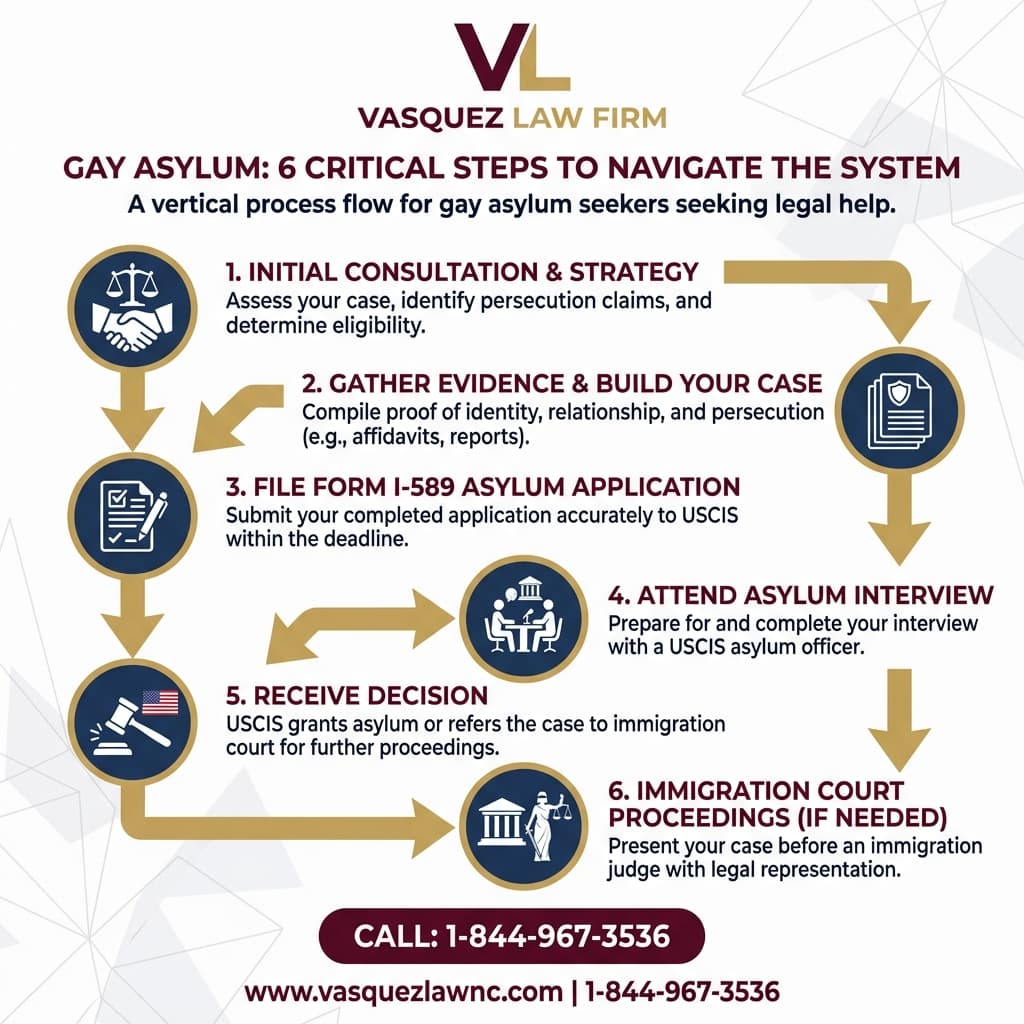
Understanding each stage of the asylum process can help manage expectations and prepare effectively. Here’s a general overview:
- Entry into the U.S. and Initial Contact: Upon arrival, individuals may express a fear of returning to their country to Customs and Border Protection (CBP) officers. This triggers a “credible fear” interview.
- Credible Fear Interview: If CBP determines you have a credible fear, you are usually allowed to pursue your asylum claim. If not, you may be subject to expedited removal, making it harder to prevent gay asylum-seeker deportation.
- Filing Form I-589: You must file this application within one year of your last arrival in the U.S., unless an exception applies. This form details your fear of persecution.
- Asylum Interview (Affirmative Cases): An asylum officer will interview you to hear your story and review your evidence. You can have a lawyer present.
- Referral to Immigration Court or Grant of Asylum: If the asylum officer grants asylum, you are protected. If denied, your case is typically referred to an immigration court for defensive asylum proceedings.
- Immigration Court Hearings (Defensive Cases): You will appear before an immigration judge, present your case, and cross-examine government witnesses. This is a formal legal proceeding.
- Decision and Appeals: The judge issues a decision. If denied, you can appeal to the Board of Immigration Appeals (BIA) and potentially to federal courts.
Every step requires precision and a deep understanding of immigration law. Our firm helps clients in Raleigh, Florida, and across the nation navigate these critical stages to avoid gay asylum-seeker deportation.
Documents and Evidence Checklist for Asylum Claims
Building a strong asylum case relies heavily on comprehensive documentation and compelling evidence. Here’s a checklist of items that can support your claim:
- Form I-589: Completed accurately and thoroughly.
- Personal Declaration/Affidavit: Your detailed personal story of persecution and fear, including specific incidents, dates, and locations.
- Identity Documents: Passport, birth certificate, national ID, or any other proof of identity.
- Evidence of Sexual Orientation/Gender Identity: Affidavits from friends/family, photos, social media posts, membership in LGBTQ+ organizations, or personal statements.
- Country Condition Reports: Reports from human rights organizations (e.g., Human Rights Watch, Amnesty International), U.S. Department of State, or news articles detailing persecution of LGBTQ+ individuals in your home country.
- Medical or Psychological Records: Documentation of physical or emotional harm suffered due to persecution.
- Police Reports or Court Documents: Evidence of harassment, arrest, or legal action taken against you.
- Witness Affidavits: Statements from individuals who witnessed your persecution or can corroborate your story.
- Proof of Membership in Organizations: Any documentation showing your involvement with LGBTQ+ groups or activism.
Gathering these documents can be daunting, but our team at Vasquez Law Firm assists clients in compiling a robust evidence package to support their asylum claims and prevent gay asylum-seeker deportation.
Common Mistakes Leading to Gay Asylum-Seeker Deportation
Even with a legitimate fear of persecution, certain missteps can jeopardize an asylum claim and lead to gay asylum-seeker deportation. Avoiding these common mistakes is critical:
- Missing the One-Year Filing Deadline: Unless an exception applies, failing to file Form I-589 within one year of your U.S. entry can result in automatic denial. Always consult an attorney immediately upon arrival.
- Inconsistent or Vague Testimony: Providing inconsistent details or lacking specific examples of persecution can undermine your credibility. Practice your story and ensure all details are consistent.
- Lack of Corroborating Evidence: While personal testimony is vital, it’s often insufficient on its own. Gather all possible supporting documents, even small ones.
- Failure to Disclose Criminal History: Hiding past arrests or convictions, even minor ones, can lead to severe penalties, including inadmissibility and deportation. Be fully transparent with your attorney.
- Not Understanding Legal Terms: Misinterpreting questions or legal jargon during interviews or hearings can harm your case. Work with an attorney to understand every aspect of the process.
- Failing to Update Contact Information: Missing crucial notices from USCIS or the immigration court can lead to orders of deportation in absentia. Always keep your address current with all agencies.
- Attempting to Handle the Case Alone: Immigration law is incredibly complex. Without legal expertise, you risk crucial errors. Retain an experienced immigration lawyer from the outset.
- Not Preparing for Interviews/Hearings: Underestimating the formality and scrutiny of interviews and court appearances. Your attorney will prepare you thoroughly for every interaction.
If you only remember one thing: Do not attempt to navigate the asylum process alone. The complexities and high stakes demand experienced legal representation to protect your rights and prevent gay asylum-seeker deportation.
Don't face your legal challenges alone. Our team is here to help you every step of the way.
Call today: 1-844-967-3536 | Se Habla Español
NC, FL, and Nationwide Immigration Notes
Immigration law in the United States is primarily federal, meaning the core statutes and regulations governing asylum and deportation apply uniformly across all states, including North Carolina and Florida. However, the practical application, local court procedures, and availability of resources can vary by region.
North Carolina Immigration Landscape
In North Carolina, immigration courts are located in Charlotte, and individuals in the Raleigh area would typically attend hearings there or potentially through video conferencing. The state has a growing immigrant population, and local non-profits and legal aid organizations often work in conjunction with private firms like Vasquez Law Firm to support asylum seekers. Understanding the specific procedures of the Charlotte Immigration Court is vital for those in North Carolina facing gay asylum-seeker deportation.
Florida Immigration Landscape
Florida, a major port of entry and home to a large immigrant community, has several immigration courts, including in Miami, Orlando, and Bradenton. The volume of cases in Florida can be very high, leading to longer processing times. Our Florida Bar-admitted attorneys are familiar with the specific nuances and practices within Florida's immigration court system, offering essential guidance for clients throughout the state. We are committed to protecting gay asylum-seekers from deportation across Florida.
Nationwide Concepts (General Only, Rules Vary)
While local court procedures may differ, the fundamental federal laws regarding asylum and deportation, such as those found in the Immigration and Nationality Act (INA), remain consistent across the nation. This includes the recognition of "particular social group" as a basis for asylum, encompassing sexual orientation and gender identity. Vasquez Law Firm represents clients not only in North Carolina and Florida but also provides nationwide immigration services, leveraging our deep understanding of federal immigration law to assist individuals from all states facing gay asylum-seeker deportation.
When to Call a Lawyer Now About Gay Asylum-Seeker Deportation
The immigration process is time-sensitive and complex. Delaying legal counsel can significantly harm your case. You should contact an experienced immigration attorney immediately if any of the following apply:
- You have recently arrived in the U.S. and fear returning to your home country.
- You are an LGBTQ+ individual and have experienced or fear persecution.
- You have received a Notice to Appear (NTA) in immigration court.
- Your asylum application has been denied by USCIS.
- You are facing any kind of detention or removal proceedings.
- You missed the one-year deadline for filing asylum but believe you have an exception.
- You need help gathering evidence or preparing your personal declaration.
- You are unsure about your eligibility for asylum or other forms of relief.
- You have a criminal history that might impact your immigration status.
- You need to appeal an immigration judge's decision.
About Vasquez Law Firm
At Vasquez Law Firm, we combine compassion with aggressive representation. Our motto "Yo Peleo" (I Fight) reflects our unwavering commitment to standing up for your rights. We understand the unique challenges faced by gay asylum-seekers and are dedicated to providing the highest level of legal advocacy.
- Bilingual Support: Se Habla Español - our team is fully bilingual and ready to communicate effectively in your preferred language.
- Service Areas: We proudly serve clients in North Carolina, Florida, and offer comprehensive nationwide immigration services.
- Experience: Attorney Vasquez brings over 15 years of dedicated experience, successfully navigating complex legal matters for thousands of clients.
- Results: Our firm has a proven track record of achieving favorable outcomes across multiple practice areas, including challenging gay asylum-seeker deportation cases.
Attorney Trust and Experience
Attorney Vasquez holds a Juris Doctor degree and is admitted to practice in both the North Carolina State Bar and Florida Bar. With over 15 years of dedicated legal experience, he has built a reputation for providing personalized attention and achieving favorable outcomes for his clients. His commitment to justice and his deep understanding of immigration law make him a formidable advocate for those facing gay asylum-seeker deportation.
Frequently Asked Questions
Can a gay person claim asylum in the U.S. based on sexual orientation?
Yes, U.S. immigration law recognizes persecution based on sexual orientation as a valid ground for asylum. This falls under the "particular social group" category, which protects individuals from countries where their sexual orientation puts them at risk of harm. You must demonstrate a well-founded fear of persecution. Vasquez Law Firm assists in building strong cases.
What evidence is needed to support a gay asylum claim?
You need to provide credible testimony about your experiences and fears. Corroborating evidence is also crucial, such as country condition reports, news articles, affidavits from witnesses, medical records, police reports, or proof of your involvement in LGBTQ+ organizations. An attorney can help you gather and present this evidence effectively.
Can an asylum seeker be deported if their claim is denied?
Yes, if an asylum claim is denied by USCIS, the case is typically referred to an immigration court where the individual faces removal proceedings. If the immigration judge also denies asylum, and all appeals are exhausted, the individual can be ordered deported. This underscores the need for expert legal representation.
What is the one-year filing deadline for asylum, and are there exceptions?
Generally, you must file Form I-589 within one year of your last arrival in the U.S. There are limited exceptions for changed circumstances that materially affect your eligibility for asylum or extraordinary circumstances relating to the delay. Consulting an attorney promptly is essential to determine if an exception applies.
How does a criminal record affect a gay asylum-seeker's case?
Certain criminal convictions can make an individual ineligible for asylum or even lead to mandatory detention and deportation. These include aggravated felonies and certain serious crimes. It is critical to disclose any criminal history to your attorney immediately, as it significantly impacts your legal strategy and options.
What is the difference between affirmative and defensive asylum?
Affirmative asylum is filed proactively with USCIS if you are not in removal proceedings. Defensive asylum is sought when you are already in removal proceedings before an immigration judge, often after an affirmative claim denial or apprehension by immigration authorities. Both paths aim for the same protection but involve different procedural steps.
What happens after an asylum claim is referred to immigration court?
If your affirmative asylum claim is referred, you will receive a Notice to Appear (NTA) and begin removal proceedings before an immigration judge. You will have hearings to present your case, witnesses, and evidence. This is a formal adversarial process where the government tries to deport you. Legal representation is non-negotiable at this stage.
Can I appeal a denied asylum claim?
Yes, if an immigration judge denies your asylum claim, you can appeal the decision to the Board of Immigration Appeals (BIA). If the BIA also denies your appeal, you may have the option to appeal to a federal circuit court. Each appeal stage has strict deadlines and complex legal requirements, making attorney assistance crucial.
What should I do if I fear gay asylum-seeker deportation?
If you fear gay asylum-seeker deportation, the most important step is to contact an experienced immigration attorney immediately. They can evaluate your situation, help you understand your rights, prepare your asylum application, and represent you in all necessary proceedings. Early legal intervention significantly improves your chances of a successful outcome.
Does Vasquez Law Firm offer services for gay asylum-seekers in Raleigh or Florida?
Yes, Vasquez Law Firm proudly serves gay asylum-seekers in Raleigh, throughout North Carolina, and across Florida. We also provide comprehensive nationwide immigration services. Our bilingual team is dedicated to fighting for your rights and offering compassionate, aggressive representation to prevent gay asylum-seeker deportation.
Sources and References
- U.S. Citizenship and Immigration Services (USCIS)
- Executive Office for Immigration Review (EOIR)
- Immigration and Nationality Act (INA) - 8 U.S.C. § 1101 et seq.
- 8 C.F.R. § 208 - Asylum and Withholding of Removal
Ready to take the next step? Contact Vasquez Law Firm today for a free, confidential consultation. We're committed to fighting for your rights and achieving the best possible outcome for your case.
Start Your Free Case Evaluation Now
Call us: 1-844-967-3536
Se Habla Español - Estamos aquí para ayudarle.


William Vasquez
Founder & CEO, Vasquez Law Firm, PLLC
William Vasquez is the founder and CEO of Vasquez Law Firm, PLLC, a results-driven firm specializing in immigration, criminal defense, personal injury, and workers' compensation. A U.S. Air Force veteran and recipient of the Joint Service Achievement Medal, William is dedicated to fiercely fighting for his clients' rights.
Related Legal Services
Need legal help? Learn more about speak with an immigration lawyer, or contact us for a free evaluation.
You can also visit North Carolina immigration lawyers for more information.